Trees show up in our dreams more often than we realise, and when they do, they tend to stay with us after we wake up. A tall green tree standing quietly in a field, a fruit tree heavy with mangoes or dates, a tree slowly losing its leaves, or one that suddenly crashes to the ground — these are the kinds of images that feel like they must mean something. And in a way, they do. Not because every dream is a message written in code, but because trees carry so much meaning in our everyday lives and in our faith that the mind naturally reaches for them when it wants to say something about growth, family, stability, or loss.
In Islamic tradition, dreams have always been treated with a kind of respectful curiosity. They are not ignored, but they are not treated as fortune-telling either. A dream can be a comfort, a warning, a reflection of what is already on your heart, or simply the mind sorting through the day. The scholars who wrote about dreams centuries ago were careful about this. They offered interpretations as possibilities, not as certainties, and they always reminded the dreamer that only Allah knows the unseen. That is the spirit this article follows. We will look at what a tree can symbolise, walk through the most common tree dreams one by one, see what the Quran says about trees, and look at what classical Islamic dream literature says — honestly, including where the sources are less certain than people assume. And at the end, there is practical guidance on what to actually do after such a dream, because a dream that leaves you thinking is worth responding to calmly, not anxiously.
Before we go further, one thing worth saying plainly: a dream about a tree does not decide your future. It does not guarantee wealth, predict a death, or promise a marriage. What it can do is give you a moment to pause and ask yourself honest questions. Is something in my life growing well? Is something I have neglected? Am I rooted, or am I feeling uprooted? Those questions are useful whether or not the dream itself was a sign. The tree in your dream might simply be your own mind holding up a mirror, and sometimes a mirror is exactly what we need.
Quick Summary
If you woke up from a dream about a tree and you only want the short version, here it is. In Islamic dream interpretation, a tree is most often understood as a symbol of a person, a family, or a life that is growing — or struggling to grow. A green, flourishing tree is generally read as a hopeful sign: faith that is alive, a family that is strong, a project or a period of life that is bearing fruit. A fruit-bearing tree often points to benefit, provision, or knowledge that helps others. A dry, leafless, or dead tree is usually read the other way: something that has lost its vitality, a relationship or habit that needs attention, or a warning to take stock before things get worse.
Climbing a tree is often read as ambition or effort — reaching for something higher, with the height you reach mattering more than the climb itself. A tree falling can feel frightening, and it is often read as the loss of support, the end of something you relied on, or a change you did not expect. Planting a tree is one of the most hopeful images of all: it suggests a good deed, a new beginning, or something you are building for the future. Sitting in a tree’s shade is usually read as rest, protection, and comfort after effort. Cutting down a tree is the most serious of these images, and it is often read as a warning — about harming something valuable, ending something too hastily, or a loss that comes from your own actions.
None of these readings are fixed rules. The same tree can mean different things depending on how it looked, how you felt in the dream, and what is happening in your life right now. A tree that made you feel peaceful probably carries a different message from one that made you feel afraid, even if both trees looked the same on paper. The sections below go through each scenario in detail, and the later sections look at what the Quran says about trees and what classical writers recorded — with an honest note about the limits of those old books.
- A green flourishing tree: life, faith, family strength, and growth.
- A dry or dead tree: neglect, loss of vitality, or something that needs attention.
- A fruit-bearing tree: benefit, provision, and knowledge that reaches others.
- Climbing a tree: ambition, effort, and reaching for something higher.
- A tree falling: loss of support or an unexpected change.
- Planting a tree: a new beginning, a good deed, or building for the future.
- Sitting in a tree’s shade: rest, protection, and comfort.
- Cutting down a tree: a warning about harming something valuable or acting too hastily.
Seeing a Green Flourishing Tree in a Dream
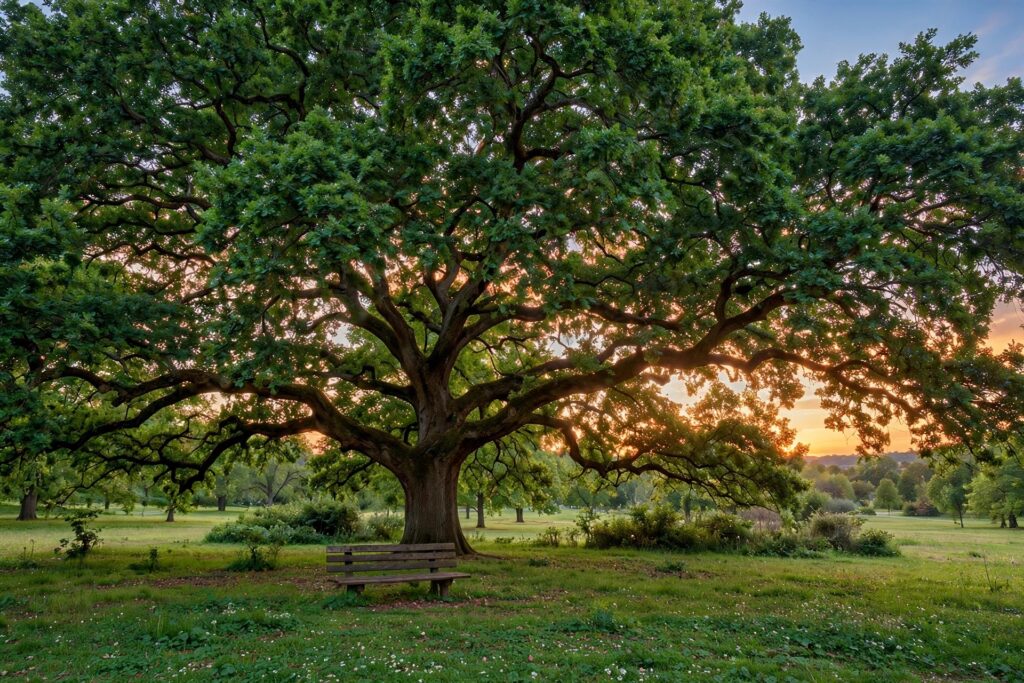
Of all the tree dreams people report, this is the most common and the most welcome: a tree full of green leaves, standing tall, maybe swaying gently in the wind, sometimes with sunlight falling through its branches. You wake up feeling calm, even happy, and the image stays with you through the morning. In the general understanding of Islamic dream interpretation, a green flourishing tree is read as a positive sign, and there are good reasons for that.
Green is the colour of life in almost every culture, and in the Quranic imagination it is tied to growth that Allah causes after rain, to gardens, and to the freshness of something that is alive and well. A tree that is green and full is doing what a tree is supposed to do. It is rooted, it is drinking, it is growing. When such a tree appears in a dream, the traditional reading is that it reflects something in the dreamer’s life that is also doing well: faith that is alive rather than routine, a family that is close and steady, health that is holding, or a piece of work that is finally taking shape after a long effort.
It helps to notice the details. A single great tree standing alone in an open field is often read as pointing to one strong person — perhaps the dreamer, perhaps a parent or an elder, perhaps a figure who holds a family or a community together. A group of green trees, like a small orchard or the edge of a forest, tends to be read more broadly: a household, a community, a circle of people who are all growing together. A young green tree, fresh and still slender, is often read as a child, a new project, or the early stage of something good. A very old, huge green tree with deep roots is often read as an elder, a long-standing family, or a tradition that has stood the test of time.
Your feeling in the dream matters as much as the tree itself. If you stood under that green tree feeling safe, the reading leans toward protection and contentment. If you were admiring it from a distance, it may reflect something you aspire to — a state of faith or family life you want to reach. If you were caring for the tree, watering it or clearing weeds from around it, the dream may be reflecting your own efforts: the quiet work you have been doing that is finally showing results, even if nobody else has noticed yet.
There is also a gentle caution that belongs here. A hopeful dream is not a promise that nothing will ever go wrong, and it is not a reason to stop taking care of the things that are going well. A flourishing tree still needs water. If anything, a dream like this can be read as encouragement to keep doing what is working: keep praying, keep showing up for your family, keep tending the work you started. The tree is green because something was done right. The dream may simply be inviting you to notice that, and to be grateful for it.
Seeing a Dry or Dead Tree in a Dream
A dry tree is a very different experience. The branches are bare, the bark is cracked, the leaves — if there are any — are brown and scattered on the ground. Sometimes the tree is clearly dead, a grey skeleton against the sky. Sometimes it is only struggling: a few green leaves clinging on while the rest has withered. Dreams like this often leave a person uneasy, and it is worth taking that feeling seriously without letting it turn into fear.
In the traditional reading, a dry or dead tree points to something that has lost its vitality. That could be many things. It could be a relationship that has gone quiet — a friendship you have not tended, a family bond strained by distance or an old argument. It could be a habit of worship that has become mechanical, prayers said on time but without presence of heart. It could be a business or a project that was once lively and is now running on empty. It could be your own energy: months of tiredness, stress, or grief that have left you feeling dried out inside.
The important thing is not to jump to the worst conclusion. A dry tree in a dream does not mean someone is going to die, and it does not mean your life is ruined. Dreams use strong images to get our attention, and a dead tree is a strong image. What it usually seems to be saying is simpler and more practical: something needs water. Something needs attention before it is too late. The hopeful part of this image is that dryness is not always final. Gardeners know that a tree that looks dead in winter can come back in spring, and a tree that has been neglected can sometimes be revived with care. The dream may be less of a verdict and more of a nudge.
Pay attention to what the tree was in the dream, if you can tell. A dry tree in a place that should be green — a garden, a courtyard, your own home — feels more personal than a dead tree in a desert, which might simply reflect a hard season of life. A tree you yourself planted and then found dry is a sharper image than a tree you merely passed on a road; it points more directly at something you are responsible for. And a tree that was dry but had one green shoot, or a single new leaf, is a hopeful detail worth holding on to: it suggests that life is still there, even if it is small.
If this is the dream you had, the practical response is straightforward. Ask yourself, honestly and without panic: what in my life have I stopped watering? Is there a relationship I should repair, a prayer I should return to with more presence, a responsibility I have been putting off? Pick one small thing and tend to it. That is a better use of the dream than worrying about what it might predict. A dry tree asks for care, not for fear.
Seeing a Fruit-Bearing Tree in a Dream
A tree heavy with fruit is one of the richest dream images there is, and it is usually read as a sign of benefit. Not just benefit for you, either — the image of a fruit tree naturally includes others, because fruit is meant to be picked and shared. A tree that only looks beautiful helps one person. A tree that bears fruit feeds many.
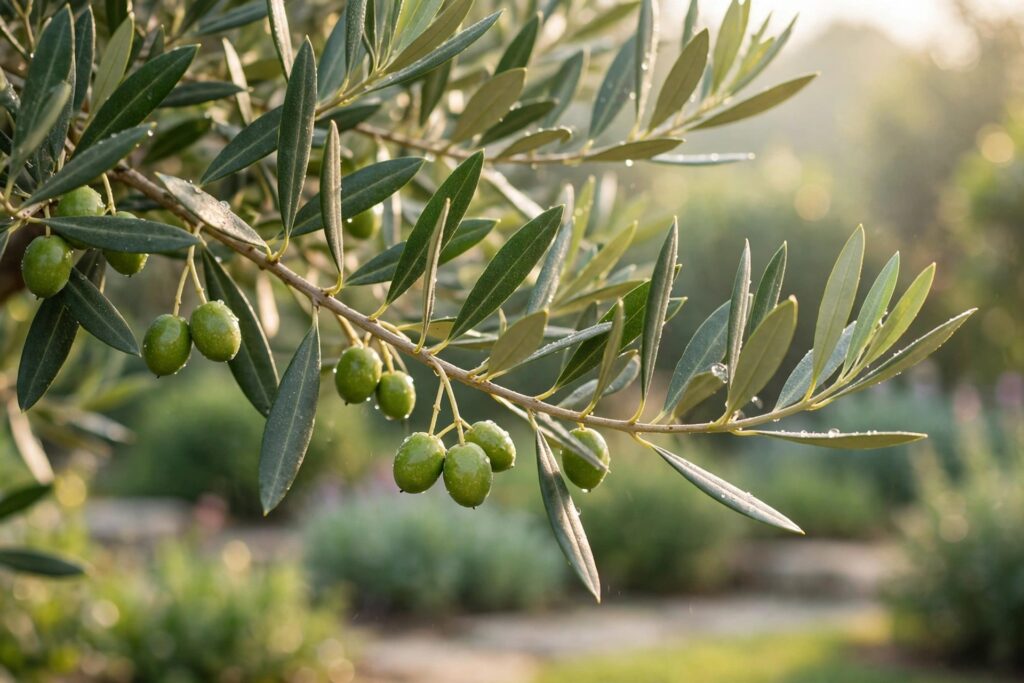
In the traditional understanding, the kind of fruit can shade the meaning, though this is where interpretation becomes more art than science. Dates and olives carry a special resonance in Islamic culture, and a tree laden with dates or olives is often read as pointing to provision that is wholesome and blessed, or to knowledge that is both useful and rooted in tradition. A tree full of sweet fruit, whatever the kind, is generally read as good news: provision, success in a lawful effort, or the sweetness of a relationship that is going well. Sour or unripe fruit is read more cautiously — something that is coming, but not ready yet, or a benefit that will need patience before it can be enjoyed.
What you were doing with the fruit matters too. Picking fruit easily, with your hands full, is read as provision that comes without great struggle, or as knowledge you are able to gather and use. Picking fruit and giving it to others is often read as generosity, or as knowledge and benefit flowing through you to other people — a teacher, a parent, or anyone whose work helps others grow. Fruit falling into your lap or at your feet is often read as provision arriving unexpectedly. Trying to reach fruit that is too high, or finding the fruit rotten when you pick it, shifts the reading toward frustration or disappointment: something you hoped for may not be what it seemed, or may need more time.
There is a beautiful Quranic image that belongs in this section. The Quran compares a good word to a good tree, firmly rooted, with branches reaching into the sky, giving its fruit at all times by the permission of its Lord (Quran 14:24-25). It is one of the most quoted images in the Quran, and it is worth sitting with. A good word — a kind word, a true word, a word of guidance — is like a tree that never stops giving. The image ties together roots, growth, and benefit, and it suggests that the best fruit a person can bear is not wealth or status, but words and deeds that keep helping others long after they are spoken. If you dreamed of a fruit tree, that image is worth remembering, because it turns the dream into a question: what fruit am I bearing? What good is growing out of my life that others can pick and be nourished by?
That question is the real gift of this dream. A fruit tree does not only ask what you will receive. It asks what you will give. And that is a generous way to read a dream — not as a forecast of what will land in your hands, but as an encouragement to become the kind of person whose life feeds others.
Climbing a Tree in a Dream
Climbing a tree in a dream is an active dream. You are not just looking at the tree; you are in it, moving up through its branches, reaching for something. Most people who have this dream remember the effort of it — the grip of the bark, the search for the next branch, the view opening up as they rise. It is a dream about striving, and the traditional reading reflects that.
In general, climbing a tree is read as ambition and effort: reaching for something higher than where you are now. That could be a goal in your work or studies, a higher station in your faith, a position of responsibility, or simply a better version of your own life. The height matters. Reaching the top of the tree, or climbing high enough to see far across the land, is usually read as success in the effort — a goal achieved, or a position reached. Climbing only partway and stopping is read more modestly: progress, but not yet arrival. Falling from the tree while climbing is a different image altogether, and it is usually read as a setback in the effort, or as a warning against climbing too fast, without a firm hold.
The kind of tree you climb can colour the reading. Climbing a fruit tree to reach its fruit is the most straightforward version of the image: effort with a clear reward in sight. Climbing a tall tree simply to see the view is often read as seeking knowledge, perspective, or a wider understanding of your life. Climbing a tree to escape something — an animal, a flood, a person chasing you — changes the meaning entirely, and it is read more as seeking safety than seeking success. The feeling of the climb matters here as well. A confident, steady climb feels very different from a frightened scramble, and a good interpretation should respect that difference.
There is a practical wisdom hidden in this image. Trees reward patient climbing. The person who tests each branch before putting weight on it gets higher than the person who rushes. If this is the dream you had, it may be worth asking whether you are climbing carefully or hastily in your waking life. Ambition is not the problem — Islam honours striving for what is good — but ambition without a firm footing can lead to a fall. The dream may be encouraging you to keep climbing, but to check your grip as you go.
Seeing a Tree Falling in a Dream
Few dream images are as startling as a tree falling. One moment it is standing, rooted and familiar, and the next it is coming down — slowly at first, then all at once, with a sound you can almost hear after you wake up. Dreams like this are frightening, and it is natural to wake up with your heart beating fast. It is worth saying first that a frightening dream does not mean a frightening event is coming. Dreams speak in feelings as much as in facts, and the feeling of a falling tree is the feeling of losing something solid.
In the traditional reading, a falling tree is most often understood as the loss of support or the end of something you relied on. A great tree can stand for a person who holds a family together — an elder, a parent, a provider — and the tree falling can reflect a fear of losing that person, or a change in their health or circumstances. It can also stand for a position, a job, a business, or a source of income that feels less secure than it used to. Sometimes it reflects a change that has already happened: a relationship that ended, a move to a new place, a stage of life that is over. The ground feels different now, and the dream shows you a tree to say so.
The details change the reading. A tree falling because of a storm or a strong wind is often read as a change that came from outside your control — circumstances, not choices. A tree that you yourself cut down and then watched fall belongs more to the cutting section below, and it points toward your own actions. A tree falling away from you, landing at a distance, feels less personal than a tree falling toward you, or onto a house, which is a more alarming image and is usually read as a disruption that reaches into your home or your closest relationships.
If you had this dream, the most useful response is not to panic but to take stock. What in my life feels like it is under pressure right now? Is there a support I have been leaning on too heavily, without a backup? Is there a relationship or a responsibility that needs attention before it becomes a crisis? Sometimes the dream is simply your mind processing a change that has already happened, and the right response is to grieve it honestly rather than to brace for another one. And sometimes it is a nudge to strengthen the roots of the things that matter — to spend time with the people who hold your life together, to make sure your own foundations are sound. A fallen tree cannot be stood back up, but a forest grows new trees. That is the longer truth this image points to.
Planting a Tree in a Dream
Planting a tree is a hopeful act in waking life, and it is a hopeful image in a dream. There is something quietly optimistic about putting a small thing into the ground and trusting that it will grow. You will not see the full result tomorrow, or even next year. You plant because you believe in a future you may not fully see. That is why this dream is so often read as a sign of goodness: a new beginning, a good deed, or something you are building for the long term.
In the traditional reading, planting a tree can point to several kinds of beginnings. It may be a new project, a new business, a new course of study, or a move to a new place. It may be a marriage or the hope of a child, since a young tree is so often read as a child in dream interpretation. It may be a good deed whose reward keeps growing — the kind of ongoing charity that benefits people long after the person who planted it is gone. A tree is one of the oldest images of a good deed that outlives the doer: it gives shade, fruit, and shelter for years, sometimes for generations, and the person who planted it keeps receiving its benefit in ways they cannot measure.
What you plant, and where, adds shade to the meaning. Planting a tree in your own garden or courtyard feels personal and close: something you are building for your own household. Planting a tree in a public place, a mosque courtyard, or a roadside is often read more broadly, as something that will benefit others. Planting many trees, a whole orchard, suggests an ambition that is generous in scale — not one good thing, but many. Watering the tree after planting it is a hopeful detail: it suggests that you are not only starting something but tending it, which is what makes the difference between a seedling that survives and one that does not.
There is a gentle lesson in this image that is worth carrying into the day. Planting is an act of trust. You cannot force a tree to grow, and you cannot rush it. What you can do is plant well, water faithfully, and be patient. If you dreamed of planting a tree, it may be that something in your life is at the planting stage right now — a decision made, a first step taken — and the dream is encouraging you to keep tending it. Do not dig it up every week to check whether it is growing. Water it, protect it, and give it time.
Sitting in the Shade of a Tree in a Dream
Sitting in the shade of a tree is one of the most peaceful dream images there is. The heat of the day, the coolness under the branches, the sound of leaves overhead — it is rest after effort, shelter after exposure. People who have this dream often wake up feeling rested, as though they really did sit somewhere quiet. In the traditional reading, that feeling is the meaning: shade is protection, rest, and comfort.
The shade of a tree can point to a person who protects you — a parent, a spouse, a mentor, or a friend whose presence makes life easier. It can point to a home, a community, or a place where you feel safe. It can point to a period of rest after a difficult time, a season in which Allah gives you ease after hardship. The Quran uses the image of shade in the context of the blessings of Paradise, where shade is abundant and lasting, and that gives the dream image a deeper resonance: the shade of a tree in a dream can be a small, earthly echo of a much greater comfort.
There is another Quranic image that belongs here. The Quran describes a blessed olive tree, neither of the east nor of the west, whose oil would almost glow even if no fire touched it (Quran 24:35). It is a verse about light, but the tree at its centre is a tree that gives — oil, light, benefit — without belonging to one place or one side. It is a reminder that the best sources of light and comfort are generous and wide-reaching, not narrow or exclusive. A tree that gives shade generously is a small picture of that generosity.
If you dreamed of sitting in a tree’s shade, it may be worth asking what has been sheltering you lately, and whether you have thanked the person — or the Provider — behind it. It may also be a permission you needed: to rest. Not every season is for striving. Some seasons are for sitting quietly under what has already grown, gathering strength for what comes next. If you have been pushing yourself without pause, this dream may be your own mind telling you what your body already knows — that rest is not laziness, and that shade is a gift to be received gratefully, not earned through exhaustion.
Cutting Down a Tree in a Dream
Cutting down a tree is the most serious of the tree images, and it is the one that most often leaves a person troubled. In a dream, the act of cutting — the axe, the saw, the slow fall of the trunk — carries a weight that other tree images do not. It is an ending that comes from a deliberate act, and the traditional reading reflects that seriousness. It is usually understood as a warning rather than a prediction.
The warning can point in several directions. Cutting down a healthy, green tree is often read as harming something valuable — ending a relationship too hastily, damaging a source of benefit, or destroying something that took years to grow for the sake of a short-term gain. Cutting down a tree that belongs to someone else is read more sharply, as harm done to another person or their interests. Cutting down a dry or rotten tree is a different image, and it is read more gently: removing something that is already dead or harmful, clearing space for new growth. The state of the tree matters, and so does your feeling while cutting it. Regret during the dream softens the reading; carelessness or anger sharpens it.
It is worth remembering here that in the Quranic story, a tree also marks a boundary. Adam and his wife were told they could enjoy the garden freely, but not to approach one particular tree (Quran 2:35). The tree in that story is not evil in itself — it is a limit, a test of obedience, a reminder that not everything within reach is meant to be taken. That story gives the image of cutting a tree an extra layer of meaning: sometimes the question is not whether we can do something, but whether we should. The ability to cut a tree down does not make cutting it wise.
If you dreamed of cutting down a tree, the practical response is to pause before any big decision. Is there something in your life you are about to end — a relationship, a job, a commitment — that deserves one more careful thought? Is there a person you might hurt with a hasty word or action? Or is there, on the other hand, something genuinely dead that you have been afraid to let go of, and the dream is showing you the cutting as a necessary clearing? Both readings are possible, and only you know which one fits. The dream does not tell you what to do. It asks you to think before you act, and that is good advice whatever the dream meant.
What Classical Islamic Dream Literature Says
It is impossible to write honestly about Islamic dream interpretation without mentioning the classical literature, and it is equally important to be honest about what that literature is. For centuries, Muslims have consulted books of dream interpretation, and the most famous name attached to them is Ibn Sirin. His name appears on countless dream books, and many of the tree interpretations people quote today — a tree as a man, a green tree as a person of faith, a fruit tree as a generous person — trace back to works published under his name.
Here is the honesty note that matters, and it is one that careful scholars have made for a long time. The works attributed to Ibn Sirin were compiled and transmitted later, and scholars differ about how much of the material in those books genuinely goes back to him. That does not mean the books are worthless — they preserve a long tradition of how Muslim communities thought about dreams, and much of what they say is wise and consistent with the Quranic images of trees as rooted, fruitful, and beneficial. But it does mean that a specific interpretation found in a dream book should not be treated as a certain religious ruling, and it should never be quoted as though it were a saying of the Prophet or a verse of the Quran. It is general tradition: the collected wisdom of generations, useful for reflection, not a source of certainty about the future.
Within that tradition, the broad pattern for trees is consistent. A tree is generally read as a person, because a tree, like a person, has roots, grows, bears fruit, ages, and eventually falls. The condition of the tree reflects the condition of the person: green and fruitful for a person whose life is going well and whose deeds benefit others; dry or barren for a person whose life has lost its vitality or whose deeds do not help anyone. A tree with many branches is often read as a person with a large family or many dependents. A tree with deep roots is read as a person of firm faith or long standing. A tree planted in a mosque or a garden is read more favourably than a tree in a barren or strange place.
The tradition also makes room for the dreamer’s own state. The same books that list meanings for trees also insist that the interpretation depends on the person who dreamed, their circumstances, their character, and their feelings in the dream. A tree dreamed by a farmer is not the same as a tree dreamed by a merchant. A tree that frightened you is not the same as a tree that comforted you. That insistence is worth holding on to, because it is the part of the tradition that keeps interpretation humble. The books offer possibilities. They do not offer verdicts.
There is one more thing the classical writers were careful about, and it is worth repeating here. They distinguished between dreams that seem meaningful and dreams that are simply the mind replaying the day, or the result of worry, illness, or a heavy meal. Not every dream deserves a search through a dream book. Sometimes a tree is just a tree your mind borrowed from a walk you took yesterday. The art of dream interpretation, in the classical view, is partly knowing when to interpret and when to let a dream pass. A dream that is vivid, that repeats, or that leaves a strong feeling is worth reflecting on. A dream you barely remember probably is not.
What to Do After Such a Dream
So you dreamed of a tree. What now? The good news is that the response is simple, calm, and entirely within your control. There is no complicated ritual and no reason for alarm. The following steps are a sensible way to respond, whether the dream was joyful or unsettling.
- First, notice how you felt. Before you look up any meaning, write down the dream in a few lines while it is fresh: what the tree looked like, what you were doing, and how you felt. The feeling is often the most honest part of the dream, and it fades faster than the image.
- Thank Allah for a good dream, and seek refuge from a troubling one. This is the simple, traditional response: gratitude for what brought peace, and a quiet turning to Allah for protection from what brought fear. You do not need to announce the dream to everyone you know.
- Do not rush to share it. Dreams are personal, and the classical guidance is to share a good dream only with someone you trust and who wishes you well, and to keep a troubling dream to yourself rather than spreading unease. There is wisdom in that: a dream grows or shrinks depending on who hears it.
- Ask what the dream might be inviting you to do. A green tree might invite gratitude and continued care. A dry tree might invite you to repair a relationship or return to a habit you have let slip. A falling tree might invite you to strengthen what is under strain. A tree you planted might invite patience. Let the dream be a question, not a verdict.
- Take one small, concrete step. If the dream pointed to a relationship, send a message or make a call. If it pointed to your worship, set aside a few quiet minutes for prayer with presence. If it pointed to a project, do the next small task. A dream that leads to one good action has done its work.
- Do not make big decisions based on a dream alone. A dream is not a substitute for thinking, for advice from people you trust, or for prayer for guidance. If a dream seems to push you toward a major choice — ending a marriage, leaving a job, a large financial decision — slow down. Talk to someone wise, think it through, and pray about it. Dreams can prompt reflection, but they should not override reason and counsel.
- If the dream was frightening, do not let it frighten you for days. A troubling dream is not a prediction. If it returns often, or if it is tied to anxiety that is affecting your sleep, it may be worth talking to someone — a trusted elder, a counsellor, or a doctor — about the anxiety itself rather than the dream. Sometimes the tree is not the problem. The tiredness is.
Above all, remember the balance that Islamic teaching keeps on this subject. Dreams matter enough to take seriously, and little enough that they should never rule your life. The tree in your dream is an image to reflect on, not a sentence to fear. Take the reflection, leave the fear, and get on with the day.
Frequently Asked Questions
Is seeing a tree in a dream a good sign in Islam?
Usually, yes — especially when the tree is green, flourishing, or bearing fruit. In the general understanding of Islamic dream interpretation, a healthy tree is read as a positive sign pointing to faith, family, growth, or provision. But the meaning depends on the tree’s condition and on how you felt in the dream. A dry or falling tree is read more cautiously, as a warning or a call to pay attention to something. No single image is always good or always bad, and no dream is a guarantee about the future.
What does a green tree mean in a dream?
A green tree is most often read as life, faith, and growth. It can point to a family that is strong, a period of life that is going well, health that is holding, or a project that is finally bearing results. A single large green tree is often read as one strong person, while a group of green trees can point to a household or community. If you felt peaceful in the dream, the reading leans toward contentment and protection.
What does a dry or dead tree mean in a dream?
A dry or dead tree is usually read as something that has lost its vitality — a relationship that has gone quiet, a habit of worship that has become mechanical, a project running on empty, or your own energy after a long period of stress. It is best read as a nudge to pay attention and tend to what needs care, not as a prediction of disaster. A tree with even one green shoot is a hopeful detail, suggesting that life is still there.
What does a fruit tree mean in a dream?
A fruit-bearing tree is generally read as a sign of benefit and provision, and because fruit is meant to be shared, it often points to benefit that reaches other people as well — knowledge, generosity, or work that helps others. Picking fruit easily is read as provision that comes without great struggle. The Quran compares a good word to a good tree that gives its fruit at all times by the permission of its Lord (Quran 14:24-25), which is a beautiful way to think about what kind of fruit your own life is bearing.
What does climbing a tree in a dream mean?
Climbing a tree is usually read as ambition and effort — reaching for something higher, whether that is a goal, a position, knowledge, or a better state of faith. Reaching the top is read as success in the effort. Falling while climbing is read as a setback or a warning against rushing without a firm hold. Climbing to escape something is read differently, as seeking safety rather than seeking success.
What does a tree falling in a dream mean?
A falling tree is often read as the loss of support or an unexpected change — the end of something you relied on, a change in a person who holds a family together, or a source of security that feels less certain than it used to. A tree felled by a storm is read as a change from outside your control, while a tree you cut down yourself points more toward your own choices. The dream is best used as a prompt to take stock and strengthen what matters, not as a reason to panic.
What does planting a tree in a dream mean?
Planting a tree is one of the most hopeful dream images, and it is generally read as a new beginning, a good deed, or something you are building for the future. It can point to a new project, a marriage, the hope of a child, or a good deed whose benefit keeps growing long after the act itself. Planting and then watering the tree is an especially hopeful detail, suggesting that you are not only starting something but tending it faithfully.
What does sitting under a tree in a dream mean?
Sitting in the shade of a tree is usually read as rest, protection, and comfort after effort. The shade can point to a person who shelters you, a home or community where you feel safe, or a season of ease after hardship. If you have been pushing yourself without pause, the dream may be a gentle permission to rest. Rest is not laziness, and shade is a gift to be received with gratitude.
What does cutting down a tree in a dream mean?
Cutting down a tree is generally read as a warning about harming something valuable or acting too hastily — ending a relationship, damaging a source of benefit, or destroying something that took years to grow. Cutting down a dry or rotten tree is read more gently, as clearing away what is already dead to make room for new growth. If you had this dream, pause before any big decision and think carefully about what you might be about to end.
Should I tell others about my tree dream?
Share a good dream only with someone you trust who wishes you well, and keep a troubling dream to yourself rather than spreading worry. This is the classical guidance, and it is practical as well as religious: a dream grows or shrinks depending on who hears it. You do not need to announce every dream, and you should never make a major life decision based on a dream alone. Talk to someone wise, think it through, and pray for guidance.
Trees are patient things. They do not hurry, they do not complain, and they keep growing quietly through seasons we barely notice. Perhaps that is why they come to us in dreams: to remind us of the slow, rooted way that good things actually grow. A tree in your dream might have been a comfort, a warning, or simply your own mind reaching for the oldest picture of life it knows. Whatever it was, it gave you a moment to stop and think about what is growing in your life, what needs water, and what fruit you hope to bear. That moment is worth keeping. Tend what is green, water what is dry, be patient with what is newly planted, and trust that the One who causes trees to grow is also the One who tends the unseen parts of your life. The rest, as with all dreams, is best left in His hands.
