Some dreams stay with you long after you wake up, and a bird is one of them. You might see a white dove sitting quietly on your window, an eagle flying high above you, a crow calling from a rooftop, or a small sparrow hopping around your room. The image feels simple, but it also feels meaningful, and that is why so many people search for its meaning the next morning.
In Islamic dream interpretation, a bird is rarely just a bird. For centuries it has been linked with freedom, news, the soul, hope, travel, and messages from far away. A bird can fly where we cannot go, cross in minutes a distance that would take us days, and sing without being taught. So when a bird appears in a dream, it is often read as a sign connected to something moving, changing, or arriving in your life.
But the meaning is never fixed. A dove and a crow do not mean the same thing. A bird flying freely does not mean the same as a bird locked in a cage. A white bird and a black bird can point in very different directions. Your own situation matters too. The same dream can feel hopeful for one person and worrying for another, depending on what is happening in their life, what they felt in the dream, and how the dream ended. This article explains the subject in a calm and honest way: the general meaning first, then different birds, colours, and situations, then what such a dream may mean for unmarried people, married people, parents, students, job seekers, and travellers, followed by a note on classical literature, practical guidance, and answers to the questions people ask most often.
Quick Summary
In short: Seeing a bird in a dream in Islam is most often linked with freedom, good news, hope, travel, or a message. A white bird, a dove, a singing bird, or a bird flying freely is generally read as a positive sign. A caged, injured, or dead bird is often read as a sign of restriction, worry, or a delay. A crow or an owl is not automatically bad — its meaning depends on what it was doing and how you felt. The colour, the type of bird, the place, and your own life situation all change the interpretation.
- White bird or dove: Often linked with peace, purity, good news, and relief.
- Eagle: Often linked with strength, ambition, honour, and a big opportunity.
- Crow: Often linked with a warning, a difficult person, or news that needs care.
- Parrot: Often linked with talk, imitation, news, or a message repeated by others.
- Sparrow: Often linked with a small blessing, a humble person, or everyday sustenance.
- Bird flying freely: Often a sign of freedom, progress, or a wish coming closer.
- Bird in a cage: Often a sign of feeling restricted, delayed, or held back.
- Bird entering the house: Often linked with a visitor, news, or a change in the household.
What Does Seeing a Bird in a Dream Mean in Islam?
In general, a bird in a dream is a symbol of something that moves. It can be news travelling towards you, a person travelling away from you, an idea taking shape, or a part of your own life that wants to be free. Birds do not stay in one place for long. They migrate, they return, they build and leave, and they sing even when no one is listening. That restless, light, hopeful quality is at the heart of most bird interpretations.
Classical dream literature often connects birds with people as well. A bird can represent a child, a traveller, a messenger, a singer, a free-spirited person, or someone who brings news. A small bird can represent a small matter or a young person. A large bird can represent a powerful person, a big opportunity, or a serious matter. A beautiful bird can represent beauty, joy, or something pleasant coming into your life. A strange or frightening bird can represent an unfamiliar situation or a person whose intentions are not yet clear.
The bird can also represent the soul and the inner life. In poetry and spiritual writing, the bird is often used as a picture of the soul because it can rise above the ground and see things from a higher place. In a dream, that can mean your inner state — whether you feel free or trapped, hopeful or tired, light or burdened. A dream of a bird flying high can sometimes reflect a heart that feels hopeful and open. A dream of a bird that cannot fly can sometimes reflect a heart weighed down by worry, debt, family pressure, or a decision that has not been made.
Why Birds Appear in Dreams
Birds appear in dreams for many reasons, and most of them are very human. We all know what it feels like to want to be free — free from a difficult job, free from debt, free from a bad relationship, or free from a place that feels too small for us. A bird gives that feeling a shape. When you dream of a bird, you may be dreaming about freedom itself.
Birds are also linked with news and messages in a very practical way. Before phones and letters, people used birds to carry messages, and even today we say that news “flies” or that someone “heard it from a little bird.” That old connection is still alive in dream interpretation. A bird in a dream is often read as news on its way — sometimes good news, sometimes news that needs patience, sometimes news from a person you have not heard from in a while.
Seeing Different Birds in a Dream
The type of bird matters more than almost anything else. A dove does not carry the same feeling as an eagle, and a sparrow does not carry the same weight as a crow. Below are the birds people ask about most often, with the meanings most commonly given in classical and popular interpretation. Read them as guidance and possibilities, not as fixed rules.
Seeing a Dove in a Dream
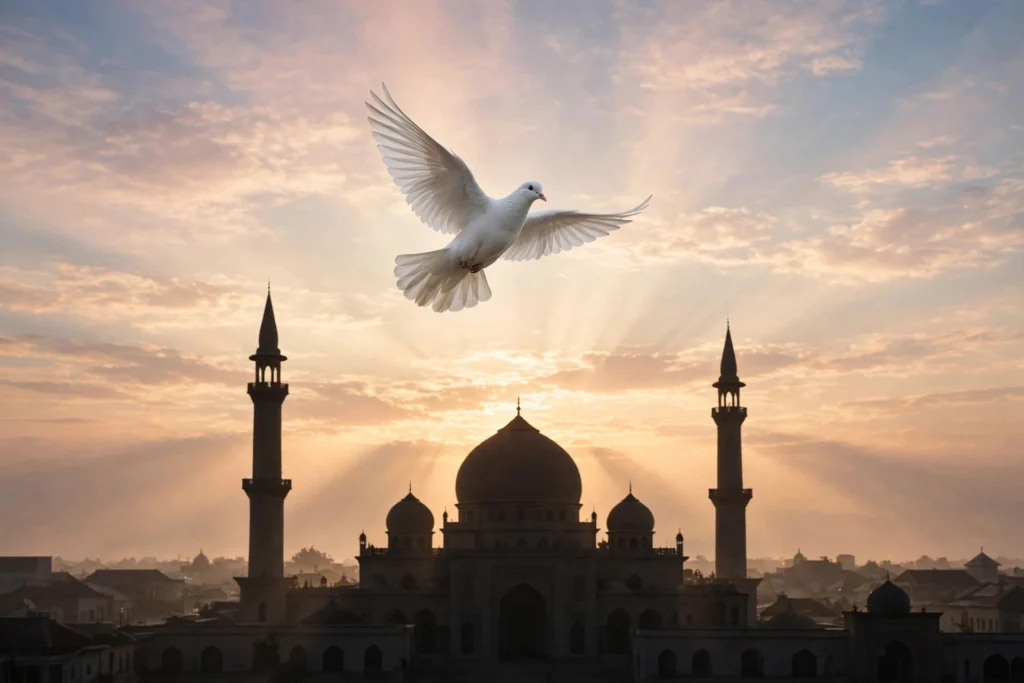
A dove is one of the most peaceful birds in dream interpretation, and it is usually read as a good sign. Doves are linked with peace, gentleness, love, faithfulness, and good news. A white dove in particular is often seen as a sign of relief after difficulty, reconciliation after a disagreement, or a gentle message arriving at the right time. If you see a dove sitting calmly, it may point to peace in the home or peace in the heart. If you see two doves together, it is often linked with love, marriage, companionship, or a close relationship becoming stronger. For an unmarried person, two doves can be read as a hopeful sign about marriage or about meeting a kind and faithful partner. For a married person, it can be read as a sign of harmony returning after a period of tension. A dove flying towards you is often read as good news coming your way, and a dove landing on your hand or shoulder is often read as a blessing that comes close to you, something personal and gentle rather than loud or dramatic. If the dove in your dream is injured or frightened, the meaning changes: it can reflect a gentle person in your life who is hurt, a relationship that needs care, or your own heart feeling fragile. It is not necessarily a bad omen — it can be a prompt to be kinder, to yourself, to your family, or to someone who depends on you.
Seeing an Eagle in a Dream
An eagle is a bird of strength, height, and vision. It flies higher than most birds, sees further, and is not easily frightened. In dream interpretation, an eagle is often linked with power, honour, ambition, leadership, and a big opportunity. An eagle flying high and strong is generally read as a very positive sign: success in a difficult task, respect from others, promotion at work, success in a business venture, or victory after a long struggle. For a student, it can point to doing well in an exam or achieving a goal that once felt out of reach. An eagle landing near you or looking at you is often read as a sign of an important person entering your life — a mentor, a leader, or someone whose support could change things for you. But an eagle can also be a warning. An eagle attacking, or one that feels threatening, can point to a powerful person who is unhappy with you, a strong competitor, or a situation where you need to be careful and wise rather than bold. An eagle that is injured or unable to fly can reflect a loss of confidence, a setback for a strong person, or a plan that needs more time before it can take off. The key is the eagle’s condition and your feeling: a strong eagle usually means strength; a struggling eagle usually means a struggle that needs patience.
Seeing a Crow in a Dream
A crow is the bird people worry about most, and it is also the bird most often misunderstood. A crow is intelligent, watchful, and loud. In dream interpretation, it is often linked with a warning, with news that is not yet clear, with a person who talks too much or who cannot be fully trusted, or with a difficult situation that needs care. Seeing a crow sitting quietly and watching you can be read as a sign to be careful — to check a piece of news before believing it, to be cautious with a promise, or to look more closely at a person or a deal. It does not mean something bad will definitely happen; it means slow down, look carefully, and do not rush. A crow calling loudly is often linked with news, gossip, or a message being repeated by others. Sometimes that news is true, sometimes it is exaggerated, and sometimes it is simply noise. The practical lesson is the same: if you hear something surprising in the coming days, verify it before acting on it. A crow entering the house or sitting on the roof is sometimes linked with a visitor, an unexpected guest, or news from far away, and it can also be linked with a disagreement in the household or a matter left unresolved. It is important to say this clearly: a crow in a dream is not a curse, and it is not a sign of death by itself. Many people fear that immediately, and that fear causes more harm than the dream. A single crow, seen once, in an otherwise ordinary dream, is usually read as a small warning or a piece of news — not as a tragedy. If you have such a dream, pray, give charity if you can, be careful in your dealings for a few days, and move on.
Seeing a Parrot in a Dream
A parrot is a bright, talkative bird, and its meaning is closely linked with speech. A parrot can represent a person who talks a lot, a person who repeats what others say, a child learning to speak, good news carried by words, or a message that needs to be heard properly. A parrot speaking clearly or repeating a pleasant word is often read as a good sign — good news, a kind word from someone, a compliment, or a conversation that brings clarity. A green parrot in particular is often read positively, linked with freshness, growth, and pleasant news. A parrot that talks too much, screams, or repeats something unpleasant can be read as a warning about gossip, about a secret being repeated, or about someone who talks without thinking. It can be a reminder to guard your own words and to be careful about what you share and with whom. A parrot in a cage is often read as a sign of words that are trapped — something you want to say but cannot say, a truth being held back, or a person whose voice is not being heard. For parents, a parrot can sometimes be linked with a child, especially a talkative, clever child who is quick to learn.
Seeing an Owl in a Dream
An owl is a night bird, quiet, watchful, and often misunderstood. In some cultures it is feared, but in Islamic dream interpretation its meaning is more careful and balanced. An owl is often linked with wisdom, watchfulness, solitude, a person who stays awake at night, or knowledge that comes in a quiet way. Seeing an owl sitting calmly can be read as a sign to pay attention — to look at something you have been ignoring, to think before you act, or to listen to advice from a wise person. An owl sees in the dark, and in a dream that can mean seeing clearly in a situation where others are confused. An owl calling at night or staring at you can feel frightening, and in popular interpretation it is sometimes linked with a warning, with loneliness, or with news that arrives at an unexpected time. But it is not, by itself, a prediction of harm. A more helpful way to read it is as a prompt: is there something in your life you are avoiding looking at, a decision you have been putting off, or wise advice you should hear? For a student or a person of knowledge, an owl can be read positively, as a sign of study and deep thinking. If the owl attacks or frightens you badly, treat it as a worrying dream in the general sense: pray, seek protection, give charity, and do not dwell on it.
Seeing a Sparrow in a Dream
A sparrow is small, common, and easy to overlook — and that is exactly why its meaning is so warm. In dream interpretation, a sparrow is often linked with a small blessing, a humble person, everyday sustenance, a child, or a modest but honest living. It reminds us that not every blessing is large. Some blessings are small, daily, and easy to miss. Seeing a sparrow hopping happily or singing is generally read as a good sign: a small joy arriving, a small amount of money or provision, a kind word, or a simple pleasure that lifts your mood. For a person worried about money, a sparrow can be a gentle reminder that provision comes in small amounts as well as large ones. A sparrow entering the house is often read as a sign of a small guest, a small piece of news, or a blessing entering the home. A sparrow building a nest can be read as a sign of settling down, of home, of marriage, or of starting a family life. Seeing many sparrows together is often read as a sign of community, family, or a group of humble, good people around you. An injured sparrow can be a tender dream, reflecting a vulnerable person in your life, a child who needs attention, or your own heart feeling small and tired. It is usually read as a call to gentleness rather than as a bad omen.
What the Colour of the Bird Means
Colour is the second most important detail after the type of bird. The same bird in white and in black can feel completely different, and classical interpretation takes that difference seriously.
Seeing a White Bird in a Dream
A white bird is one of the most positive images in dream interpretation. White is linked with purity, peace, honesty, and light. A white bird — especially a white dove, pigeon, or swan — is generally read as a sign of good news, relief, forgiveness, a clean start, or a blessing that comes without trouble. For a person who has been worried, it can be read as a sign that relief is near. For someone who has repented after a mistake, it can be read as a sign of a fresh start. A white bird flying in a clear sky suggests the way ahead is open, and a white bird landing near you suggests the blessing is close, not far away. If the white bird is dirty, injured, or trapped, the meaning softens: it can reflect a good person or a good intention that is struggling, or a pure matter that has become complicated. It is still not a bad omen — it is a prompt to protect what is good.
Seeing a Black Bird in a Dream
A black bird is the colour people fear most, and it deserves a calm explanation. Black is linked with the unknown, with night, and with seriousness. A black bird is not automatically a bad sign, but it is usually read as a sign to be careful and to think. A black crow or raven sitting quietly can be read as a warning about a person, a piece of news, or a decision — there is something here you have not seen clearly yet. It can also be linked with a difficult period or with sadness, and for a person going through a hard time it can simply reflect how heavy life feels right now. A black bird flying away can be read as a worry leaving or a dark period coming to an end — often more positively than a black bird arriving. Do not let a single colour decide the whole meaning. Look at what the bird was doing and how you felt. A black bird singing happily is a very different dream from a black bird attacking in the dark.
Seeing a Colourful or Green Bird in a Dream
A colourful bird — a parrot with green and red feathers, a peacock, a kingfisher, or a bird with bright blue or yellow wings — is generally read as a joyful sign, linked with variety, happiness, celebration, and the beauty of life. It can point to a happy event, a pleasant surprise, or a brighter period. A green bird carries a special meaning in Islamic culture, where green is linked with life, growth, and freshness. A green parrot is the most common green bird in dreams and is usually read as a sign of pleasant news and growth. A blue bird is often linked with calm and peace of mind. A red bird is linked with strong feeling — love, passion, or urgency — and its meaning depends on whether it felt warm or aggressive. A golden or yellow bird is often linked with wealth, light, and joy. A grey or brown bird represents everyday life, a humble person, or a modest blessing — ordinary blessings are still blessings, and a calm, ordinary dream can be a sign of a calm, ordinary life, which is itself a gift.
Seeing a Bird in Different Situations
The action in the dream is just as important as the bird itself. A bird flying, singing, caged, or lying still are four very different dreams.
Seeing a Bird Flying in a Dream
A bird flying is the most common bird dream, and it is usually read as a positive sign. Flying is freedom. A bird flying high and strong can point to progress, success, a wish taking flight, or a matter moving forward after a long delay, and it can also point to travel. A bird flying towards you is often read as news or a visitor coming to you; a bird flying away can mean a departure or a matter leaving your hands. Which feels good depends on what you wanted. A bird flying in a storm, struggling against wind and rain, can reflect a struggle in your own life — you are moving forward, but it is hard. The dream is not necessarily predicting failure; it may be showing you your own effort and reminding you to keep going.
Seeing a Bird Singing in a Dream
A singing bird is a happy image in almost every tradition. In Islamic dream interpretation, it is often linked with good news, pleasant words, praise, joy, and a happy occasion — a wedding, a birth, a success, or a reunion. A bird singing in the morning is often read as a sign of a good start, and a bird singing outside your window can be read as news that will reach you soon and will be pleasant to hear. If the song felt beautiful and you woke up happy, take it as a good sign and be grateful. If the song felt sad, strange, or too loud, the meaning can be different: a sad song can reflect a longing or a person you miss, while a harsh song can reflect gossip or a conversation becoming too much. A bird that tries to sing but cannot can be read as a sign of words held back — your own, or someone else’s.
Seeing a Bird in a Cage in a Dream
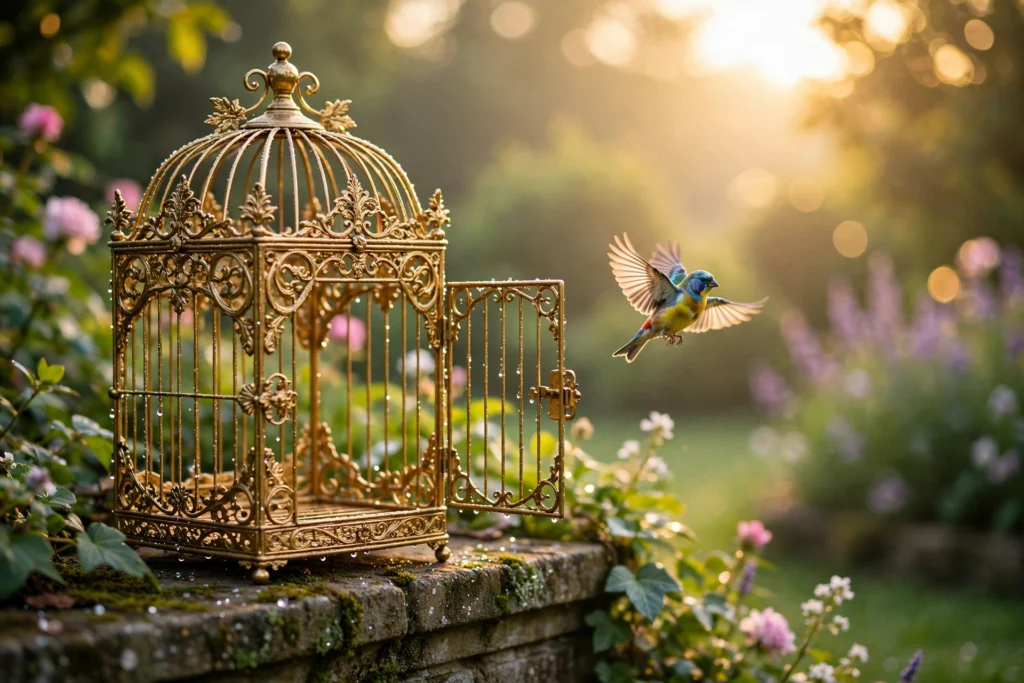
A caged bird is a dream of restriction: something that should be free is not free. It can represent you, or someone close to you, feeling trapped, limited, or unable to live freely. If you feel sad in the dream, it may be reflecting a feeling you already have — a job that feels like a cage, a relationship that feels restrictive, a debt or responsibility that holds you back. If you open the cage and set the bird free, that is usually read as a very positive sign of release and a problem being solved. If you cannot open it, the situation may need more time, more help, or a different approach. A bird in a beautiful golden cage can mean a comfortable restriction: a life that looks good from the outside but feels limited from the inside. The dream may be asking you to look honestly at whether comfort is enough, or whether you need freedom as well.
Seeing a Dead Bird in a Dream
A dead bird worries many people, and it needs a calm explanation. It does not automatically mean that someone will die. That is a common fear, but it is not how classical interpretation usually reads this dream. A dead bird is more often read as a sign of an ending — the end of a hope, a plan, or a matter, a disappointment, or a small loss. Seeing a dead bird in your house can feel more personal, sometimes read as a disappointment in the household or a matter in the family that needs attention, but it is not a prediction of a death in the family by itself. If you have this dream and feel worried, pray for your family, give charity, check on the people you love, and move on. Seeing a dead bird that comes back to life, or one that looks dead and then flies away, is a hopeful turn, often read as a sign of recovery or of hope returning after disappointment.
Catching, Feeding, and Holding a Bird
Catching a bird is often read as a sign of achieving something — getting a job, winning an opportunity, receiving money, or solving a difficult problem. Catching it gently and holding it safely is usually a good sign; catching it and letting it go can mean a temporary gain; trying and failing can mean a missed opportunity that needs a different approach. Feeding a bird is a kind and generous image, usually read as a good sign of charity, kindness, and providing for others. Feeding a bird by hand suggests trust and closeness, and feeding a baby bird is often linked with children and with providing for a family. Holding a bird in your hands is a dream of closeness and trust. Holding it gently suggests you are handling a delicate matter well; holding it too tightly can be a warning that you are holding on too tightly to something that needs room to breathe; letting it go willingly can mean letting go with grace. An injured bird is a tender image, often read as a sign of a vulnerable person or a delicate matter. If you help it in the dream, that suggests compassion and healing. If it recovers and flies away, it is often read as a sign of recovery.
A Bird Entering the House, Attacking, or Building a Nest
A bird entering the house is often linked with a visitor, news, or a change in the household. A small, gentle bird entering calmly is generally a good sign; a white bird entering is read even more positively. A bird building a nest inside the house is a warm image, often linked with settling down, marriage, a new home, or a child. A bird attacking you is often read as a warning about a conflict or a person speaking against you. A small bird pecking can mean a minor annoyance; a large bird attacking can mean a more serious conflict. If you defend yourself or the bird flies away, it is often read as a sign you will overcome it. A flock of birds means many matters or many people: flying together in a clear sky is generally positive, suggesting unity and a group moving in the same direction, while a flock scattering can reflect confusion or disagreement. A nest or eggs are signs of potential and beginnings: a nest with eggs can mean a plan, a pregnancy, or a hope not yet hatched but alive, and an egg hatching is usually read as a good sign of a beginning coming to life.
What It May Mean for Different Life Situations
The same bird can mean different things for different people, because their lives are not the same.
For an unmarried person, a bird dream is often linked with marriage or meeting someone. A dove, a pair of birds, a bird building a nest, or a colourful bird singing are commonly read as hopeful signs. A bird flying towards you can be read as a proposal or meeting coming closer. But a dream is encouragement, not a promise about a specific person. Marriage decisions need prayer, family consultation, good character, and practical thinking. For a married person, two birds together, a bird singing in the house, or a bird building a nest can be read as signs of harmony and stability. A caged bird can reflect feeling restricted in the marriage, and a bird flying away can reflect a fear of distance. Use such a dream as a reason to talk and listen, not to accuse your spouse.
For parents and people hoping for a child, a small bird, a baby bird, or a bird in a nest is often read in connection with a child — their health, growth, or future. A nest with eggs, a baby bird hatching, or a bird feeding its young are images people in this situation find hopeful, though they are never a guarantee. For a pregnant woman, a white or singing bird is generally read as a hopeful sign, but a dream is not medical advice — always follow your doctor’s guidance. For a student, an eagle flying high can point to high aims and doing well, while a caged bird can reflect pressure from exams or family expectations. For a job seeker or business owner, a bird flying towards you or landing near you is often read as a hopeful sign of an opportunity or a door opening, a flock can represent many customers or small sales, and a bird flying away can mean a customer leaving or a deal falling through — a reason to look honestly at your work, not a reason to panic. For a traveller or a person far from home, a bird is almost always linked with the journey: a bird flying in the direction of travel can be a hopeful sign for a safe journey, and a pigeon returning home is a classic image of a safe return. For a person going through a difficult time, a white bird or a bird flying freely can be a sign of hope — a reminder that relief can come — while a caged or injured bird can simply reflect how heavy life feels. Be gentle with yourself, pray, talk to someone you trust, and take small practical steps.
Is Seeing a Bird in a Dream Good or Bad?
Most bird dreams lean towards good. Birds are creatures of the sky, of lightness, of song, and of movement, and in most interpretations they are linked with hope more often than with harm. A bird that is free, healthy, singing, or flying well is almost always read as a good sign. A bird that is trapped, injured, or dead is read as a warning or a sadness, but even then it is usually a warning about a matter, not a prediction of a disaster. Judge your own dream with three questions: how did the bird look, what was it doing, and how did you feel? Peace and happiness in the dream are good signs in themselves. Fear and heaviness are worth taking seriously, but they are not proof that something bad will happen. Remember the Islamic guidance on dreams in general: receive a good dream with gratitude and share it only with people you trust; do not share a frightening dream widely, and follow it with prayer and seeking protection. Do not let a frightening dream ruin your day or your week.
A Note on Classical Literature: Ibn Sirin and Imam Jafar Sadiq
Many articles about Islamic dream interpretation mention two names again and again: Ibn Sirin and Imam Jafar Sadiq. Both are respected figures in the history of dream interpretation. Ibn Sirin, who lived in the early Islamic centuries, is associated with one of the most famous works on dream interpretation in the Islamic tradition, and Imam Jafar Sadiq is also associated with traditions of interpretation passed down and quoted in many later books. It is important to be honest about what can and cannot be verified here. Many sayings are attributed to these scholars in popular books and websites. Some attributions are well established; others have been copied, shortened, or added to over centuries, and it is not always possible to trace a specific interpretation back to a specific verified source. For that reason, this article does not attribute any single interpretation above to a specific numbered saying of Ibn Sirin or Imam Jafar Sadiq, and it does not quote any hadith or Quranic verse with a number that has not been verified. The interpretations given here come from classical dream literature generally — from the broad tradition of Islamic dream interpretation shared and discussed by scholars over many centuries — combined with the common understanding ordinary Muslims have used for generations.
What to Do After Seeing a Bird in a Dream
If the dream felt good: Be grateful. Say Alhamdulillah, even quietly to yourself. You can share a good dream with a person you trust, if you wish. Think about what it might be encouraging you to do — to keep working, to stay hopeful, to take an opportunity, or to make a decision you have been putting off — and take one small, practical step in that direction. If the dream felt worrying: Do not panic, and do not share it widely. Pray, seek protection, and give charity if you are able to, even a small amount. Look at your life calmly: is there a decision you need to make more carefully, a person you need to be cautious with, or a health issue you should check? Take the practical step the dream points to, and then let the worry go. In both cases: write the dream down if it felt important — what bird, what colour, what it was doing, how you felt — so you can see a pattern if it repeats. And do not make a major life decision, such as ending a marriage, quitting a job, or investing a large amount of money, on the basis of one dream alone. Do not pay someone who promises an interpretation for money and gives you a frightening prediction.
Frequently Asked Questions
Is seeing a bird in a dream a good sign in Islam?
In most cases, yes — especially if the bird is healthy, free, singing, or flying well. A white bird, a dove, or a bird flying in a clear sky is generally read as a good sign, linked with good news, freedom, hope, or relief. A caged, injured, or dead bird is read more cautiously, as a sign of restriction or difficulty.
What does seeing a white bird in a dream mean?
A white bird is generally read as a very positive sign, linked with purity, peace, good news, relief after difficulty, and a clean start. For a person who has been worried, it can be read as a sign that relief is near.
What does seeing a crow in a dream mean? Is it bad?
A crow is not automatically bad, though it is often read as a warning. It can point to news that needs checking, gossip, or a situation that needs care. It is not, by itself, a sign of death or a curse. Be careful for a few days, verify news before acting on it, pray, and move on.
What does a bird entering the house in a dream mean?
It is often linked with a visitor, news, or a change in the household. A small, gentle bird entering calmly is generally a good sign. A bird building a nest inside the house is often linked with settling down, marriage, or a new beginning in the family.
What does a dead bird in a dream mean?
It is usually read as a sign of an ending — the end of a hope, a plan, or a matter, a disappointment, or a small loss. It does not automatically mean that someone will die. If the bird comes back to life or flies away, it is often read as a hopeful sign of recovery.
Can a bird dream be about marriage?
Yes, very often. Two birds together, a dove, a bird building a nest, or a colourful singing bird are commonly read as hopeful signs about marriage, especially for an unmarried person. But a dream is encouragement and hope, not a promise about a specific person or date.
Final Thoughts
A bird in a dream is a small image with a large meaning. It can speak of freedom and of restriction, of news and of silence, of love and of loss, of a journey beginning and of a home being built. The best way to read such a dream is slowly and honestly: remember the bird, its colour, what it was doing, where it was, and how you felt, then look at your own life and ask what fits. A dream that encourages you should lead to gratitude and to one small, good action. A dream that worries you should lead to prayer, to care, and to one small, wise action. In both cases, the dream is not the end of the story — you are. If you woke up feeling hopeful, hold on to that hope and carry it into your day. If you woke up feeling uneasy, pray, be careful, be kind, and let the unease pass. Birds fly, and they also return. Seasons change, and so do our lives.
Note: The interpretations in this article are based on classical Islamic dream literature generally and on common popular understanding. They are offered as guidance for reflection, not as fixed predictions. No specific hadith or Quranic verse number has been quoted here, and no interpretation should be taken as a guarantee about the future.
