Seeing a Flood in a Dream
There are dreams that fade the moment you open your eyes, and then there are dreams that stay with you all morning. Seeing a flood in a dream is almost always the second kind. You wake up with the sound of rushing water still in your ears, the image of streets turning into rivers still in your mind, and a question that will not leave you alone: what did that mean? Was it a warning, or just a dream?
If you have had this dream recently, you are not alone. Floods are one of the most common water dreams people report, and they have been written about in Islamic dream literature for centuries. Water is a powerful symbol. In real life it gives life and it takes it away. It can be a gentle rain that makes the fields green, or a rising river that sweeps away everything in its path. A dream about a flood carries that same double nature, and that is why it can feel both frightening and meaningful at the same time.
This article walks through what seeing a flood in a dream can mean in Islam, the most common versions of this dream and what each one may suggest, what the classical dream literature says, and what you can actually do after waking up from such a dream. Nothing here is a guaranteed prediction. A dream is never a verdict on your future. Its meaning depends on the details of what you saw, on the water itself, and on what is happening in your own life right now.
Meaning in Brief
In short, a flood in a dream is generally understood in Islamic dream interpretation as a sign of something overwhelming — an event, a trial, or a wave of emotion that feels bigger than you. A flood is water out of control, water that has left its banks and its boundaries. In the classical understanding, that is the heart of the symbol. It may point to a difficulty approaching in your life, a time of testing, or a situation that feels as though it is rising around you faster than you can handle.
But the water itself changes the meaning a great deal. Clear, clean floodwater is read very differently from muddy, dirty water. A flood that recedes quickly is read differently from a flood that destroys everything in its path. A flood that spares your house is read differently from a flood that enters it. And being swept away and surviving is not the same as watching a flood safely from a distance. The scenarios below go through the most common versions of this dream one by one, so you can find the one closest to what you actually saw.
One thing is worth saying before we begin. A troubling dream about a flood does not mean that a flood is coming to your town, and it does not mean that something bad is certain to happen to you. Dreams in the Islamic understanding are not fortune-telling. A frightening dream can be a reason to pray, to take stock of your life, and to prepare yourself with patience and good deeds — and that preparation is valuable whether or not anything happens. What you do after the dream matters far more than the dream itself.

Common Scenarios and Their Meanings
Below are the versions of this dream people report most often. Read the one that matches your dream, and take from it what fits your own situation. Where a scenario has more than one possible reading, both are given — because in real life, the same dream can mean different things for different people.
Floodwater Entering Your House
This is one of the most common flood dreams, and also one of the most unsettling. You are inside your home, and water starts coming in under the door, through the windows, or rising up through the floor. Your home is supposed to be the safest place you know, and watching water invade it feels like watching your safety itself come undone.
In traditional interpretation, a house in a dream often represents your own life, your family, and your sense of security. Floodwater entering the house is therefore read as a difficulty or a worry entering your personal life — something that touches your home, your family, or your peace of mind. It may be a financial pressure, a family disagreement, an illness, or simply a period of stress that has found its way inside, even though you tried to keep it outside.
It is worth asking yourself what has been pressing on your home life lately. Has something been building up that you have been ignoring? Has a small problem been allowed to grow because nobody dealt with it in time? A dream like this is often less a warning about the future and more a picture of the present — a picture of something you already feel but have not yet put into words. The right response is practical and calm: look at what is actually troubling your household, and take one small step to deal with it.
Escaping a Flood to High Ground
In this dream, the water is rising, but you do not stay where you are. You climb to higher ground — a hill, a rooftop, a mountain — and from up there you watch the water spread out below you. You may feel frightened while you are climbing, but once you reach the top, there is a sense of relief.
This is generally read as a hopeful dream. In the classical understanding, reaching high ground in a flood is a sign of safety after danger, of finding a way out of a difficulty. It suggests that even if a trial comes, you will find protection, or that you have the good sense and the support to rise above it. The climb itself matters too: it may reflect a real effort you are making in your life right now, an effort to get yourself out of a hard situation.
If you have been struggling with something — a debt, a difficult relationship, a decision that has been weighing on you — this dream may be your own mind showing you that there is a way up and out. It does not promise that the struggle will disappear overnight, but it does suggest that safety is reachable. Keep doing what is right, keep asking for help when you need it, and keep moving toward higher ground, one step at a time.
Floodwater Receding
You dream of a flood, but instead of rising, the water is going down. The streets are starting to appear again, the water is pulling back, and the world is slowly returning to normal. You may feel a deep sense of relief as you watch it happen.
In traditional interpretation, receding floodwater is read as a sign that a difficulty is passing. Whatever has been weighing on you — a period of worry, a family problem, a time of hardship — may be coming to an end, or at least easing. The water going down is the image of a trial losing its force, of things returning to their proper place.
This dream is also a reminder of something true about real life: most difficulties do pass. A flood, however frightening, does not stay forever. The water rises, and then it falls. If you are in the middle of a hard time right now, a dream of receding water can be a reason for hope, and a reason to be patient a little longer. Keep going, keep praying, and trust that the water will go down.
Clean, Clear Floodwater
Not all floodwater in dreams is dirty. Sometimes the water is clear and clean, almost beautiful, even as it covers the land. It may be so clear that you can see the ground beneath it, and there is no smell of mud or filth about it.
In the classical literature, clean water is a very different symbol from dirty water. Clean water is associated with provision, mercy, and blessing. A flood of clear water is therefore sometimes read as an abundance of something good — provision coming in a large amount, or a time of plenty — rather than as a punishment. The flood is still overwhelming in its size, but what it brings is not harm.
That said, even clean water out of its bounds can cause trouble, and the dream should not be read as a simple promise of wealth. It may also reflect a feeling of being overwhelmed by something good — a new responsibility, a big opportunity, a change that is larger than you expected. The question to ask yourself is whether the water in your dream felt like a blessing or like a burden. Your own feeling in the dream is often the best guide to its meaning.
Muddy, Dirty Floodwater
This is the version of the dream that frightens people most. The water is brown and thick with mud, full of dirt and debris, and it smells bad. It covers everything and leaves filth behind wherever it goes.
In traditional interpretation, dirty water is read as a sign of trouble, hardship, or something unclean entering your life. A flood of muddy water may point to a difficult time ahead, a dispute, an illness, or a situation involving dishonesty or wrongdoing. The mud in the water is what carries the meaning: it is the difference between a trial that is clean and a trial that is tangled up with other problems.
If you have had this dream, do not panic. A dream of dirty water is not a sentence, and it does not mean that trouble is certain. It is a prompt to look at your life honestly. Is there a situation that has become messy — a disagreement that has grown bitter, a habit that is harming you, a decision you know is not right? The dream may simply be showing you the mess you already know is there, and inviting you to clean it up, one step at a time, before it grows any larger.
A Flood in the Streets of Your City
In this dream, the flood is not in your house but in your city. The streets have become rivers, the cars are half-submerged, and people are wading through water where they used to walk. You may be watching it from a window, or you may be out in it yourself.
A flood that covers a whole city is read in the classical literature as something that affects a community rather than a single person. It may point to a public difficulty — a time of hardship in your town or country, a period of unrest, or a shared trial that touches many people at once. The dream is less about your private life and more about the world around you.
It is also worth considering a simpler explanation. If you have been watching news about floods, or if flooding has been in the headlines where you live, your mind may simply be replaying what it has seen. Dreams often take the images of the day and turn them into a story at night. If the dream left you worried about others, let it move you to something good: a prayer for people who are suffering, or a small act of help for someone in need.
A Flood at Night
Some people dream of a flood that comes in the dark. The water rises while the world is asleep, and by the time anyone notices, it is already everywhere. The darkness makes the dream feel more frightening, because you cannot see where the water is coming from or how deep it is.
In dream interpretation, night often represents uncertainty, or a time when things are hidden. A flood at night may therefore point to a difficulty that arrives without warning, or to a worry that you have been carrying in the dark — something you have not spoken about, or a fear that only comes to you when you are alone with your thoughts.
If this dream has stayed with you, ask yourself what you might be avoiding looking at in the daylight. Sometimes the things we refuse to think about during the day find their way into our dreams at night, dressed up as water in the dark. Bringing them into the light — talking to someone you trust, making a plan, or simply naming the fear — can take away much of their power.
A Flood Destroying Houses
In this dream, the flood is not just covering the land — it is destroying it. Houses collapse, walls fall, roofs are carried away, and whole neighbourhoods are left in ruins. It is a painful dream to wake up from, because it feels like watching everything people have built being undone.
In the classical understanding, a flood that destroys buildings is read as a severe trial, one that touches the foundations of people’s lives. It may point to a time of real hardship in a community, or to a personal crisis that shakes the things you have relied on — your income, your home, your plans for the future. The destruction in the dream is the image of stability being shaken.
Even so, it is important to remember what floods do in real life: they destroy, but people rebuild. A dream of destruction is not a prediction that your life will fall apart. It may be a picture of a fear you already carry — the fear of losing what you have worked for — and that fear deserves to be faced honestly rather than pushed aside. If the dream has left you anxious, use it as a reason to take stock: what is truly secure in your life, what depends on things that could change, and what would you do if a difficulty came? Having a plan, even a simple one, takes away much of the fear.
Being Swept Away by Floodwater and Surviving
This is a dramatic dream. The water catches you, pulls you off your feet, and carries you along. You are tumbling, struggling to breathe, and then — somehow — you find your footing again, or you are washed up safely on the bank. You wake up with your heart pounding, but also with a strange sense of relief.
In traditional interpretation, being swept away and surviving is read as a sign of coming through a trial safely. The being swept away is the difficulty itself: a period in which you feel out of control, carried by forces larger than you. The surviving is the hopeful part. It suggests that even if you are overwhelmed for a time, you will come through it, by the mercy of God.
Many people have this dream during a time when they genuinely feel out of control — a job loss, a health scare, a family crisis, a period when everything seems to be happening at once. The dream may be your own mind working through that feeling, and rehearsing the outcome you hope for: that you will survive it. Hold on to that hope. Keep doing the small things you can control, keep praying, and trust that the current will not carry you further than you can bear.
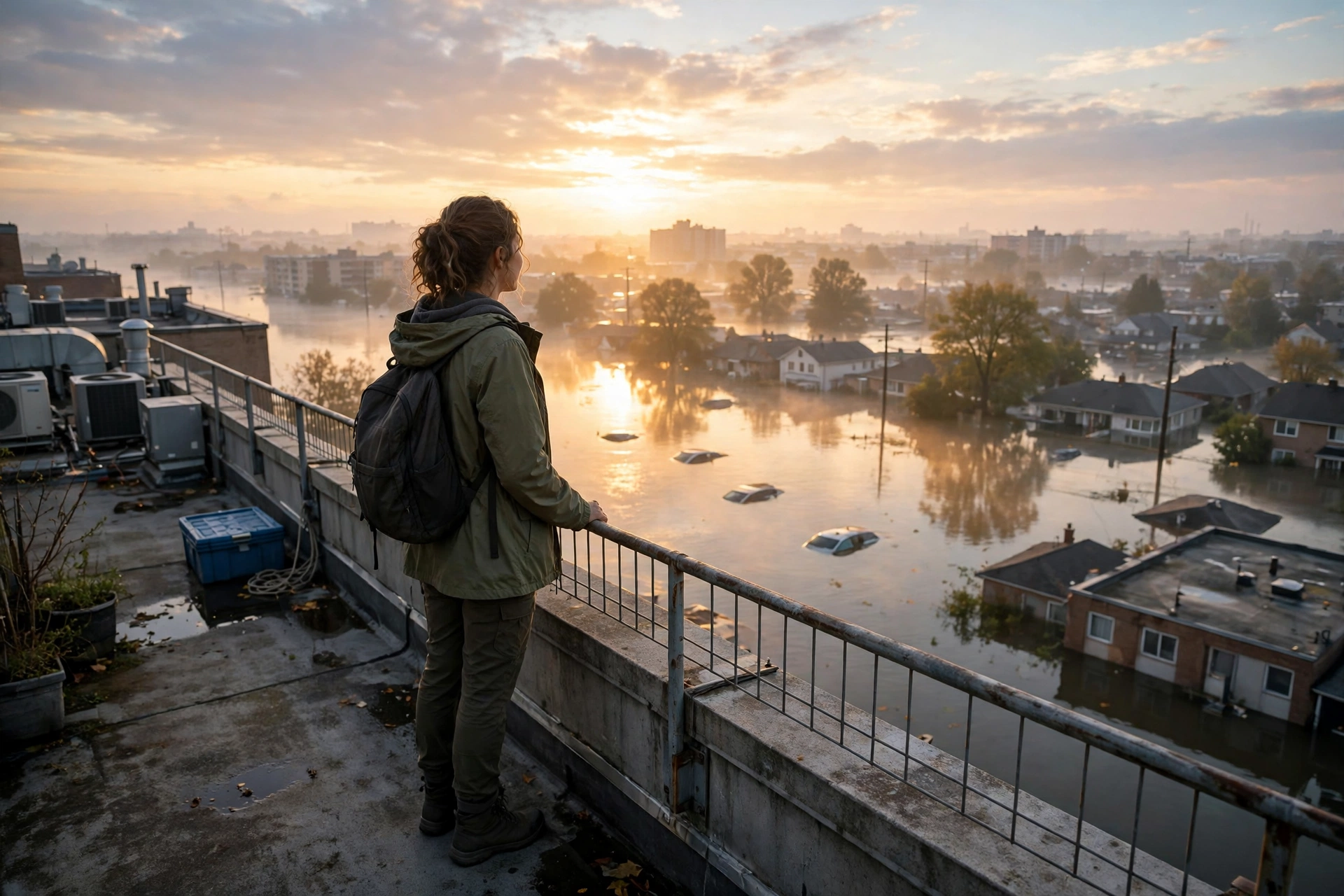
Watching a Flood From a Safe Place
In this dream, you are not in the water at all. You are watching it from a window, a rooftop, or a hill — safe, dry, and at a distance — while the flood spreads out below you. You may feel concern for the people down there, but you yourself are not in danger.
This is generally read as a sign of protection. In the classical literature, watching a difficulty from a place of safety suggests that a trial may come near you without reaching you, or that you will be spared from a hardship that affects others. It can also be a reminder to be grateful for the safety you have, and to think of those who do not have it.
There is another reading worth considering. Watching a flood from a safe place can also reflect a feeling of distance from other people’s troubles — knowing that something is wrong in the world, or in someone else’s life, but feeling unable to help. If the dream left you with a sense of guilt as well as relief, let it move you to action: a prayer for those who are struggling, a phone call to someone who is going through a hard time, or a small kindness that reaches beyond your own safety.
A Flood of Rainwater
Sometimes the flood in the dream does not come from a river or a sea, but from the sky itself. Rain falls and falls, harder and harder, until the ground cannot take any more and the water begins to rise everywhere. The rain may be heavy and steady, or it may be a sudden storm.
Rain in Islamic dream interpretation is a rich and often positive symbol. Rain is associated with mercy, provision, and life — it is what makes the earth green after it has been dry. A flood caused by rain is therefore read with that meaning in mind. Some classical interpreters read heavy rain that leads to flooding as an abundance of provision, or as a great blessing arriving all at once.
But rain that floods is still rain out of measure, and the classical literature is careful about that. A blessing that arrives in overwhelming amounts can still be hard to manage. The dream may point to a big change coming into your life — a new job, a marriage, a move, a large sum of money — something good, but larger than you expected. The right response is gratitude, and also preparation: think about how you would handle a sudden change, and make sure your feet are on solid ground before the rain begins to fall.
Floodwater in a Mosque or Place of Worship
Dreaming of floodwater inside a mosque, or inside any place of worship, is a dream that troubles many people, because a mosque is a sacred place. Water covering the prayer hall, rising around the minbar, or flooding the courtyard can feel like a disturbing image, and people often worry about what it could mean.
In the classical literature, a place of worship in a dream often represents the spiritual life of a community — its faith, its gatherings, its shared devotion. Floodwater entering such a place is therefore sometimes read as a sign of a trial affecting the religious life of a community, or as a time when people are tested in their faith. It is not a judgement on any one person, and it should not be taken as a sign that you personally have done something wrong.
There is also a gentler reading. Water in a mosque can be a picture of cleansing — of a community being washed and renewed, of old divisions being swept away. If the water in your dream was clean and the mosque was not destroyed, that reading may fit better. Either way, the practical response is the same: look after your own prayer and your own connection with God, keep attending the mosque, and be a source of calm and kindness in your community. A dream about a sacred place is best answered with a return to that place in waking life.
A Flood That Spares Your House
In this dream, the flood covers everything around you — the streets, the neighbours’ houses, the fields — but your own house stays dry. The water comes right up to your door and stops, or flows around your home without entering it. You wake up feeling relieved, and perhaps a little guilty about that relief.
This is traditionally read as a sign of divine protection. In the classical understanding, a house spared by a flood suggests that a trial may pass over you and your family, or that you will be kept safe while others face difficulty. It is one of the more hopeful flood dreams, and people who have it often wake up feeling grateful.
That gratitude is the right response — and it is also a call to humility. Being spared is not something to boast about, and it does not mean you are better than your neighbours. It is a reason to pray for those who were not spared, and to help them if you can. If the dream has left you feeling thankful, let that thankfulness show itself in a good deed: a prayer for others, a word of comfort, or a helping hand.
Floodwater Reaching Your Feet
This is a smaller, quieter dream. The flood is not huge and dramatic. The water simply rises until it reaches your feet, or your ankles, and then it stops. You are standing in shallow water, looking down at it, wondering what to do next.
In dream interpretation, water that reaches only the feet is read as a small difficulty, or a warning at an early stage. It suggests that a problem is beginning to touch your life, but has not yet overwhelmed you. There is still time to act, still time to step back onto dry ground, still time to deal with the matter before it grows.
This dream is worth taking seriously precisely because it is small. The best time to deal with a problem is when the water is only at your ankles, not when it is at your neck. Ask yourself what small trouble has started to touch your life — a debt that is growing, a disagreement that is cooling a friendship, a habit that is quietly costing you. Deal with it now, while it is still small, and you may never have to face the larger flood.
A Flood Carrying Away Belongings
In this dream, you watch as the floodwater carries away your belongings — furniture, clothes, books, things you have collected over years. You may try to grab them as they float past, or you may simply stand and watch them go. The feeling is one of loss, and of helplessness.
In traditional interpretation, belongings in a dream often represent the things you value and rely on: your wealth, your possessions, your plans, your sense of stability. A flood carrying them away may point to a fear of loss, or to a real loss that is already happening — money slipping away, a business struggling, or a period in which you feel that what you have worked for is not secure.
It can also be a reminder of something the Islamic tradition teaches often: that worldly belongings are temporary, and that what truly lasts is what you do with them. A dream of losing your possessions can be painful, but it can also be freeing — a reminder to hold things lightly, to be generous while you have them, and to invest in what cannot be carried away by water: your character, your family, your faith, and your good deeds. If the dream has left you worried about money, take a calm look at your finances, make a simple plan, and trust that provision comes from God, not from the things you own.
What the Classical Literature Says
Dreams have been discussed in Islamic scholarship for a very long time, and water is one of the most written-about symbols in that literature. The best-known name associated with this field is Ibn Sirin, a respected scholar of the early Islamic period whose name became attached to a large body of dream interpretation. It is worth being honest about the history here: the famous book of interpretations that circulates under his name was compiled later, and scholars differ on how much of it can be traced directly to him. That is why the interpretations in this article are described as tradition attributed to Ibn Sirin and the classical dream literature, rather than as his certain words.
What that tradition generally says about floods is that a flood is a powerful and serious symbol. In the classical reading, a flood is most often understood as a trial, an overwhelming event, or a test that comes upon a person or a community. It may be read as a time of hardship, or as a punishment for wrongdoing in a community when the water is destructive and the people have turned away from what is right. The flood of Noah is mentioned in this context in the classical literature as the great example from the Quranic account of a flood as divine punishment — a flood that came upon a people who had rejected the message of their prophet, and that spared only those who believed and boarded the ark. It is mentioned here in general terms, as the Quranic account describes it, without quoting wording from the Quran.
But the classical literature does not read every flood as punishment. The same tradition also says that when the water is clear, clean, and beneficial, a flood can be read as abundance of provision — a great amount of good arriving at once, like a river overflowing its banks in a year of plenty. The meaning, in other words, depends on the water. Clean water that helps the land is a different sign from dirty water that destroys it. The scholars who wrote about dreams were careful about this distinction, and it is the most important part of reading a flood dream: look at the water first, and then look at what it did.
Another principle from the classical tradition is worth remembering. Dreams are understood to come in different kinds: some are meaningful, some are simply the mind sorting through the day, and some are troubling dreams that are best ignored rather than dwelled on. The scholars advised that a good dream can be shared with people you trust, while a disturbing dream should not be given too much weight — and should certainly not be used to make major life decisions on its own. Above all, the classical literature treats dream interpretation as an art of reflection, not a science of prediction. No interpreter, classical or modern, can tell you with certainty what your dream means. The interpretations are possibilities to think about, not rulings to obey.
What to Do After Such a Dream
A dream about a flood is only as valuable as what you do with it. A frightening dream is best answered with calm, practical steps — not with panic, and not with endless worry about what might happen. Here are some gentle, practical things you can do after waking up from a flood dream.
- Do not panic, and do not treat the dream as a prediction. A dream of a flood does not mean a flood is coming, and it does not mean that something bad is certain to happen. Take a breath, remind yourself that it was a dream, and let the fear pass before you decide what it might mean.
- Pray and ask for protection. If the dream troubled you, the simplest and most encouraged response is to pray. Ask God for protection from harm, for patience in difficulty, and for safety for yourself and your family. Prayer turns a frightening dream into an act of worship, and that is a good exchange.
- Look at your life honestly. Ask yourself whether there is a difficulty already rising around you — a financial pressure, a family problem, a habit that is getting out of hand. A flood dream often pictures something you already know. Deal with it calmly, one step at a time, while the water is still low.
- Take practical precautions. If the dream has made you think about real risks — your home, your savings, your health — use that as a reason to be sensible. Make sure your important papers are safe, set aside a little money if you can, and look after your health. Practical preparation is a good answer to any worrying dream.
- Give charity. Giving to others is one of the most encouraged responses to a troubling dream in the Islamic tradition. It does not need to be large. Helping someone in need, feeding a hungry person, or supporting a good cause are all ways of turning a worrying dream into something good.
- Be kind to those around you. Floods in dreams often involve other people — neighbours, family, whole towns. If the dream has left you thinking about others, act on it. Check on a family member who is struggling, call a friend you have not spoken to, or help someone who is going through a hard time.
- Do not share a troubling dream widely. The classical advice is to share a good dream with people you trust, and to be cautious about repeating a frightening one to everyone you meet. If the dream is still worrying you after a day or two, talk it over with one person you trust — a family member, a friend, or someone knowledgeable — rather than carrying it alone.
- Keep a brief note of it. If the dream felt important, write down what you saw and how it made you feel. Over time, you may notice patterns — dreams of water appearing when you are under stress, or when a big change is coming — and understanding those patterns can help you understand yourself better.
Frequently Asked Questions
Is seeing a flood in a dream a bad sign in Islam?
Not necessarily. In the classical tradition, a flood is most often read as a trial or an overwhelming event, but its meaning depends on the water. A flood of clean, clear water can be read as abundance and provision, while a flood of muddy, destructive water is read as hardship. A flood that recedes, or one that you escape safely, is read as a hopeful sign. A dream is a reason for reflection and prayer, not a guarantee of any particular outcome.
What does it mean if floodwater enters my house in a dream?
Floodwater entering your house is generally read as a difficulty or a worry touching your personal or family life — something that has found its way inside your home, even though your home is supposed to be safe. It may be a financial pressure, a family disagreement, or a period of stress. The practical response is to look at what is actually troubling your household and take one small step to deal with it, rather than worrying about the dream itself.
What does it mean to dream of escaping a flood?
Escaping a flood — especially by reaching high ground — is generally read as a hopeful sign. It suggests safety after danger, and that you will find a way through a difficulty, even if the difficulty itself is real. It may also reflect a real effort you are making in your life to get yourself out of a hard situation. Keep going, and keep asking for help when you need it.
Does dreaming of a flood mean a real flood is coming?
No. A dream of a flood does not predict a real flood, and it should not be treated as a weather forecast. Dreams use the images of water and flooding to picture feelings and situations in your life — feeling overwhelmed, facing a big change, or worrying about something you cannot control. If you live in an area where flooding is a real risk, it is always sensible to be prepared, but that is good sense in waking life, not something the dream itself has told you.
What is the difference between clean and muddy floodwater in a dream?
The difference is central to the classical interpretation. Clean, clear water is associated with mercy, provision, and blessing, so a flood of clean water is sometimes read as abundance arriving in a large amount. Muddy, dirty water is associated with trouble and hardship, so a flood of dirty water is read as a more difficult trial. When you try to understand your own dream, the condition of the water is the first thing to look at.
What should I do after dreaming about a flood?
The best response is calm and practical: pray and ask for protection, give charity if you can, look honestly at any difficulty in your life and take one small step to deal with it, and be kind to the people around you. Do not share a troubling dream widely, and do not let it fill you with fear. A good dream should lead to gratitude, and a troubling one should lead to prayer and good deeds — that is the response the Islamic tradition encourages.
A Final Thought
Water is one of the oldest symbols in the world, and it carries both life and danger in the same element. A flood in a dream holds that double nature: it can picture a trial, a time of testing, or a wave of change that feels bigger than you — and it can also picture abundance, mercy, and a fresh start once the waters go down. Which reading fits your dream depends on the water you saw, on what it did, and on what is happening in your life right now.
Whatever your dream was, the most honest way to respond is also the simplest. Do not let it frighten you into doing nothing, and do not let it excite you into making promises it never made. Pray, take stock of your life, help someone if you can, and carry on. Floods rise, and floods recede. What remains after the water goes down is what you built on solid ground — and that is worth your attention far more than any dream.
