Seeing a Mountain in a Dream: Islamic Meaning and Interpretation
There is something about a mountain in a dream that stays with you after you wake up. It is not like dreaming about a room, or a road, or a person you know. A mountain is big. It fills the whole dream. Sometimes you are standing at the bottom of it looking up, and your neck hurts just from the size of it. Sometimes you are already halfway up, breathing hard, wondering why you started climbing in the first place. And sometimes you are standing right on the top, with the wind in your face and the whole world spread out below you, and for a moment everything feels quiet and clear.
If you woke up from a dream like that and came looking for what it means, you are not alone. Mountains are one of the most common dream symbols people search for, and for good reason. In everyday life, a mountain is the picture we use when we talk about something hard, something big, or something that will take time. We say “I have a mountain to climb” when work is piling up. We say “he moved mountains for his family” when someone did something that seemed impossible. So it makes sense that when a mountain shows up in a dream, it usually has something to do with a challenge, a goal, a person with power, or a part of your life that feels heavy and important at the same time.
In Islamic dream interpretation, a mountain is generally understood as a symbol of strength, steadfastness, a great or powerful person, a high rank, or a big obstacle that stands between you and what you want. Which one it is depends on the details. A green mountain does not mean the same thing as a dark, rocky one. Climbing easily is a very different dream from falling off the side. Standing on the top is different again from staring at a mountain far away and never getting any closer.
That is why this article does not give you one short answer and stop there. A mountain dream is worth slowing down for. Below, we will go through the meaning step by step, look at the most common situations people actually dream about, talk about what the classical books of dream interpretation say in general terms, and finish with what you can sensibly do after a dream like this. Nothing here is a prediction about your future, and nothing here is meant to frighten you. Think of it as guidance — a way to look at your own life through the picture your dream gave you.
Quick Answer: What Does Seeing a Mountain in a Dream Usually Mean?
If you only want the short version before you read the rest, here it is. Seeing a mountain in a dream often points to something large in your waking life — a goal that matters to you, a difficulty that feels too big to move, a person who holds authority over you, or a quality in yourself such as patience, firmness, or ambition. If the mountain looks beautiful, green, or peaceful, the meaning leans towards something good: honour, stability, success after effort, or a strong person who supports you. If the mountain looks dark, steep, crumbling, or frightening, the meaning leans more towards a worry, a burden, a difficult person, or a task that will need real effort and time.
How you felt in the dream matters as much as what you saw. Feeling calm while looking at a mountain is a different sign from feeling afraid of it. Climbing with steady steps is different from slipping and sliding backwards. Reaching the top is different from giving up halfway. So as you read the scenarios below, try to remember not just the mountain itself, but where you were, what you were doing, who was with you, what the weather was like, and how you felt when you woke up. Those small details are what turn a general symbol into something that actually fits your life.
What a Mountain Represents in Islamic Dream Interpretation
To understand a mountain dream, it helps to start with what a mountain is in real life, because dream interpretation in the Islamic tradition often works that way. It takes something you know from the world around you and asks what that thing stands for. A mountain is tall, so it stands for something high — a high position, a big ambition, a person of high rank. A mountain is heavy and hard to move, so it stands for something firm and unmoving — a strong character, a stubborn problem, a promise that does not bend. A mountain is hard to climb, so it stands for effort, patience, and the slow work of getting somewhere worth going.
Mountains also appear in the Quran as signs of Allah’s creation — firm, fixed, and part of the balance of the earth. You do not need a verse number to feel that meaning. Anyone who has stood in front of a real mountain knows the feeling: you feel small, but you also feel that something bigger than you is holding the world steady. That feeling carries over into dreams. A mountain can remind you of Allah’s power and greatness, and of how small our worries can look when we step back and see the bigger picture. For some people, a mountain dream comes at a time when they feel shaken, and the mountain is a reminder to stand firm. For others, it comes when they are chasing something big, and the mountain is the picture of that goal itself.
There is another side to it as well. In classical dream literature, a mountain is often linked with a great man — a king, a ruler, a leader, a wealthy or powerful person, or someone whose word carries weight. That does not mean every mountain dream is about a king in the old sense. In your life today, that “great person” might be a father, an employer, a teacher, a community elder, or anyone whose decision affects your future. If you dream of a mountain, it is worth asking yourself: is there someone like that in my life right now? Am I trying to reach them, please them, get past them, or stand beside them?
At the same time, a mountain can stand for a task rather than a person. A new job, a big exam, a house you are trying to buy, a marriage you are preparing for, a debt you are trying to clear, a habit you are trying to change — all of these can feel like a mountain. The dream does not always tell you whether you will succeed. What it often does is show you how you see the task in your own mind. Do you see it as beautiful and worth climbing, or as dark and impossible? Are you already on your way up, or are you still standing at the bottom, putting it off?
Strength, Patience, and Standing Firm
One of the most hopeful meanings of a mountain is strength. A mountain does not move when the wind blows. It does not fall down when it rains. It stays where it is, season after season. When you dream of a mountain that looks solid and calm, it can reflect a strength in your own life — your patience, your faith, your ability to keep going when things are hard. It can also point to a person who is like that for you: someone steady, someone you can lean on, someone who does not panic when trouble comes.
This meaning fits especially well if you have been going through a difficult time and the mountain in your dream felt peaceful rather than threatening. You might have woken up feeling strangely calm, even though the dream itself was about something huge. That calm feeling is worth paying attention to. It may be your own heart telling you that you are stronger than you think, or that the difficulty in front of you will not last forever. Mountains look permanent, but in a dream they can also be a reminder that firmness and patience are qualities you already carry inside you.
A High Goal or a High Position
Because a mountain rises above everything around it, it is also a natural picture of ambition. A high position at work, a degree you are studying for, a business you want to build, a level of religious practice you want to reach — these are all “high” things, and the dream mind often pictures them as a mountain top. If you have been thinking a lot about a goal lately, and then you dream of a mountain, the connection may be quite simple. Your mind is showing you the goal in picture form.
What matters here is not just the mountain, but your relationship to it. Were you looking up at it with hope, or with dread? Were you climbing it step by step, or were you stuck at the bottom? Did you have a path, or were you trying to climb a sheer cliff with no footholds? The answers to those questions often mirror how you feel about the goal in real life. If the climb felt possible, even if it was hard, that is usually a good sign about your own attitude. If the mountain felt impossible, it may be worth asking whether the goal itself needs to be broken into smaller steps, or whether you need help, or more time, rather than more worry.
An Obstacle, a Burden, or a Difficult Person
Not every mountain dream feels hopeful, and it would not be honest to pretend otherwise. Sometimes a mountain is simply in the way. You want to get to the other side, and there it is — huge, blocking the road, with no way around it. Dreams like that often come when a person feels blocked in waking life. It might be a family disagreement that will not move, a financial problem that keeps growing, a health worry, or a decision you cannot make because someone else is standing in the way.
In this kind of dream, the mountain may stand for that obstacle itself, or for the person connected to it. Classical interpreters often noted that a mountain can represent a powerful, stubborn, or hard-hearted person — someone who is difficult to persuade and difficult to move. If that rings true for you, do not take the dream as a sentence that nothing will ever change. Take it as a picture of how the situation feels right now. Obstacles in dreams, like obstacles in life, sometimes have a path around them, a pass through them, or a way over them that you have not noticed yet because you have been staring straight at the rock face.
Seeing a Mountain in a Dream: The Most Common Scenarios
Now let us look at the situations people dream about most often. Read the ones that match your dream closely, but also read the ones around them. Sometimes a dream has two or three elements at once — you might be climbing a green mountain in the rain, for example — and the meaning comes from putting those pieces together rather than from one piece on its own.
Climbing a Mountain in a Dream
Climbing a mountain is probably the most common mountain dream of all, and it is also one of the most personal. The climb is you, making an effort. It is the picture of working towards something that matters. If you were climbing steadily, finding footholds, and making progress, even slowly, this is generally understood as a good sign. It suggests effort that is paying off, or will pay off if you keep going. It does not promise that the road will be easy. A mountain climb is never easy. But steady progress in a dream often reflects steady progress in life — the kind that comes from showing up day after day, even when the top still looks far away.
Pay attention to how the climb felt. Were you tired but determined? That is a very human dream, and it often matches real life closely. Most worthwhile goals feel exactly like that: tiring, sometimes frustrating, but still worth it. Were you climbing with a clear path and good shoes, or were you scrambling, slipping, and grabbing at loose stones? A clear path often suggests that you have a plan, or that the way forward is clearer than you feared. A difficult scramble may suggest that you feel unprepared, or that you are trying to do something without enough support. Neither version is a final verdict. Both are useful information about how you feel right now.
It also matters whether you were climbing alone or with others. Climbing alone can mean independence — you are carrying this goal yourself, and you are learning to trust your own strength. Climbing with family, friends, or a guide can mean that you have support, or that you need to lean on it more. If someone in the dream was helping you up, or holding your hand on a steep part, that person may represent real help in your life, or a wish for help that you have not asked for yet. If someone was pulling you down or blocking your path, think carefully about who that might be in waking life, and whether the dream is showing you a tension you have been avoiding.
And then there is the question of whether you reached the top. If you reached it in the dream, or you could see the top getting closer, that is often read as a hopeful sign — a goal coming within reach, a difficulty nearing its end, or a period of effort finally bearing fruit. If you woke up before you reached the top, do not treat that as a failure. Dreams rarely finish the whole story. Waking up mid-climb often just means the work is still in progress in your life, and your mind is still turning it over.
Climbing a Mountain Easily
Some people dream that they climb a mountain with surprising ease. The path is smooth, their legs feel light, the air is clear, and before they know it they are near the top. If that was your dream, it is usually read as a positive sign. It can suggest that a task you have been dreading will turn out to be easier than you expected, or that Allah will open a way for you that you did not see coming. It can also suggest that you have more ability than you give yourself credit for. Sometimes we build a mountain up in our minds until it looks impossible, and then when we actually start, we find our footing quickly.
This kind of dream can also be about a person in authority becoming easy to deal with. A father who seemed strict, a boss who seemed unapproachable, a process that seemed full of paperwork and delays — sometimes the ease in the dream reflects a softening in real life, or a reminder not to assume the worst before you try. Of course, an easy climb does not mean you should stop putting in effort. It means the effort may be met with help, or with a smoother road than the one you imagined. Take it as encouragement, and keep walking.
Struggling to Climb a Mountain
The opposite dream is just as common: you are climbing, but every step is hard. Your feet slip. The slope gets steeper. You are out of breath. You look up and the top seems no closer than when you started. Some people wake up from this dream feeling exhausted, as if they really had been climbing all night. If that sounds familiar, do not panic. A hard climb in a dream is not a prediction that you will fail. More often, it is a picture of how heavy something feels right now.
Think about what in your life feels like that climb. Is it work? Money? A relationship? Your health? Your studies? Your efforts to become more regular in prayer or to give up a habit that has held you for years? A struggle dream often appears when you are already working hard but not seeing results yet. It can be your mind’s way of saying, “This is tiring, and I need to be honest about that.” That honesty is useful. It might mean you need rest, or a different approach, or help from someone else, or simply more time. A mountain does not get climbed in one rush. Climbers rest, they take on water, they go slowly on the steep parts. If your dream climb was exhausting, ask yourself whether you have been trying to rush something that needs a slower, steadier pace in real life.
There is also a gentler reading. In classical interpretation, difficulty in a dream is sometimes linked with the idea that a reward is greater when the effort is greater. A hard climb that you keep going on, even slowly, can be a picture of patience and perseverance — qualities that are highly valued in Islam. The dream may not be telling you to give up. It may be telling you that you are in the middle of the hard part, and that the hard part is not the whole story.
Standing on Top of a Mountain
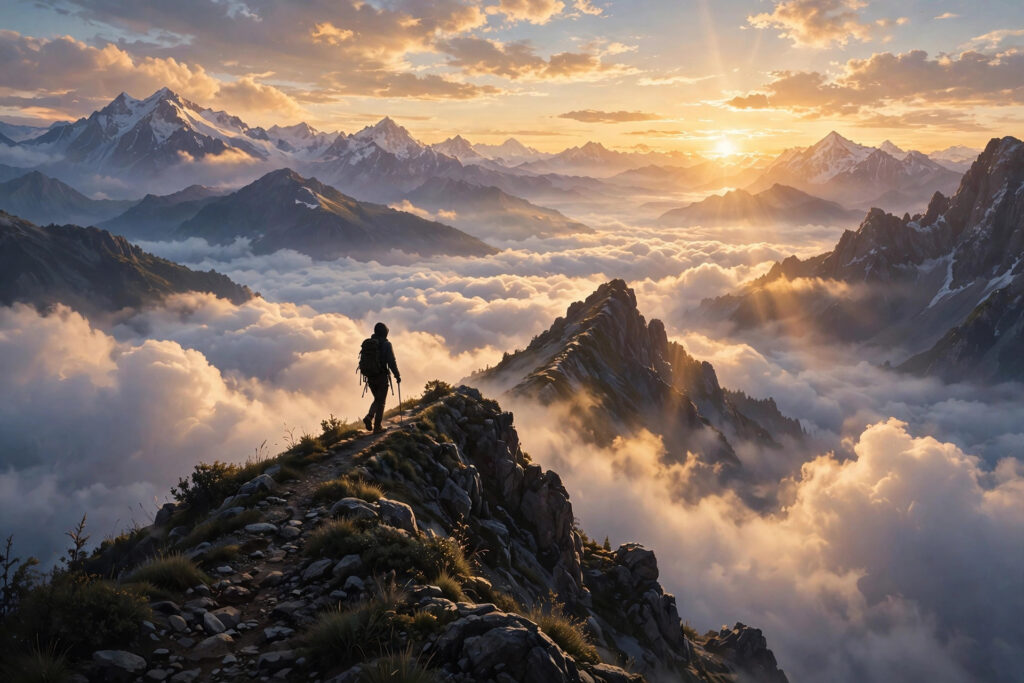
Standing on the top of a mountain in a dream is a powerful image, and most people wake up from it feeling something strong — relief, pride, peace, or sometimes a strange kind of loneliness. Looking out from a summit, everything below looks small and ordered. The problems that felt huge from the ground look different from up there. That change in perspective is often the heart of the meaning.
Generally, standing on a mountain top is understood as a sign of reaching a high position, achieving a goal, gaining honour, or finding clarity after confusion. It can point to success in a matter you have been working on, respect from others, or a sense of having overcome something that once frightened you. For a student, it might reflect an exam or a degree. For someone at work, it might reflect a promotion or recognition. For someone going through a personal struggle, it might reflect the moment when things finally make sense, or when a weight lifts.
But the feeling on the top matters too. If you felt peaceful and grateful, that is a good sign — it suggests contentment and a heart at rest. If you felt proud in a humble, thankful way, that also fits. If you felt arrogant, or looked down on the people below you, the dream may be carrying a quiet warning about pride. A mountain top is a high place, and high places in dreams can sometimes warn us not to let success go to our heads. If you felt afraid on the top — afraid of the height, afraid of falling, afraid of being alone up there — that may reflect a worry about a new responsibility. Reaching a high position brings its own pressures, and the dream may be showing you that you are thinking about those pressures even as you want the success.
Some people dream of standing on a mountain top and calling the adhan, or praying, or simply looking at the sky. Dreams like that often feel deeply spiritual, and they are usually read in a hopeful way — as a sign of closeness to Allah, of a prayer being heard, or of a heart turning towards what matters most. You do not need to over-analyse a dream like that. Sometimes the feeling itself is the message: you were high up, you were at peace, and you felt close to something greater than yourself.
Falling from a Mountain in a Dream
Falling from a mountain is one of the dreams that frightens people most, and it is understandable to wake up with your heart racing. You may have felt the drop, the wind, the sudden loss of solid ground under your feet. Before you worry, remember something important: a falling dream is very common, and it very rarely means what the fear in the moment suggests. In dream interpretation, falling is often linked with a loss of position, a setback, a fear of failure, or a feeling that something you relied on is no longer steady.
If you fell from a mountain in your dream, ask yourself what has felt unsteady in your life lately. Have you lost a job, or are you afraid of losing one? Has a relationship changed? Has your health, your income, or your confidence taken a knock? The fall may be a picture of that feeling — not a prediction that you will fall further, but a reflection of the shock of something changing. Sometimes the fall also points to a high position itself: the higher you climb, the more frightening a fall feels, and the dream may be showing you the pressure that comes with responsibility or success.
What happened after the fall matters a great deal. Did you land safely? Did someone catch you? Did you wake up before you landed? Did you get up and start climbing again? Many people wake up just before landing, which is very common in falling dreams generally. That does not mean something bad was about to happen. It usually means the dream ended at the point of greatest fear, which is how the mind often works. If you landed safely in the dream, or you survived the fall, that is often read as a hopeful sign — a setback that you will recover from, a difficulty that will not destroy you, or a lesson learned without lasting harm.
If the fall felt like it came from pride or carelessness — you were showing off on a ledge, or you stepped too close to the edge — the dream may be a gentle reminder to be careful, to stay humble, and not to take risks with something precious. If the fall came because the rock gave way under you, it may be about trust: something or someone you thought was solid turned out not to be. Either way, do not carry the fear of the dream into your whole day. Say a short prayer, take a breath, and look at the facts of your life as they are, not as the fear in the dream made them seem.
A Mountain Blocking Your Path
Dreaming of a mountain blocking your path is a different feeling from climbing one. When you climb, you have chosen the mountain. When it blocks your path, you did not choose it — it is simply there, in the way of where you want to go. You might have been walking along a road, driving, or travelling, and suddenly the mountain was in front of you, too big to go around and too steep to climb.
This kind of dream often reflects a feeling of being stuck. There is something you want — a job, a marriage, a move, a decision, a reconciliation — and something stands between you and it. That something might be a person, a rule, a lack of money, a family situation, or a fear inside yourself. The dream shows you the block as a mountain because that is how big it feels. It is worth asking, in a calm moment, what the block actually is. Sometimes when you name it clearly, it turns out to be smaller than the mountain in the dream. Sometimes it really is large, and the dream is telling you that you will need patience, help, or a different route.
Notice whether there was a way through in the dream. Was there a pass, a tunnel, a path around the side, a valley between two peaks? If there was, that detail may be the most hopeful part of the dream. It suggests that even though the obstacle looks total from the front, there is a way through that you have not tried yet. If there was no way through at all, and you simply stood and looked at the mountain, the dream may be reflecting a time of waiting. Not every block is meant to be forced. Some situations need time, prayer, and a change in circumstances before the way opens. The dream does not tell you which one it is — but it can prompt you to look for the pass instead of only staring at the rock.
Seeing a Green Mountain in a Dream
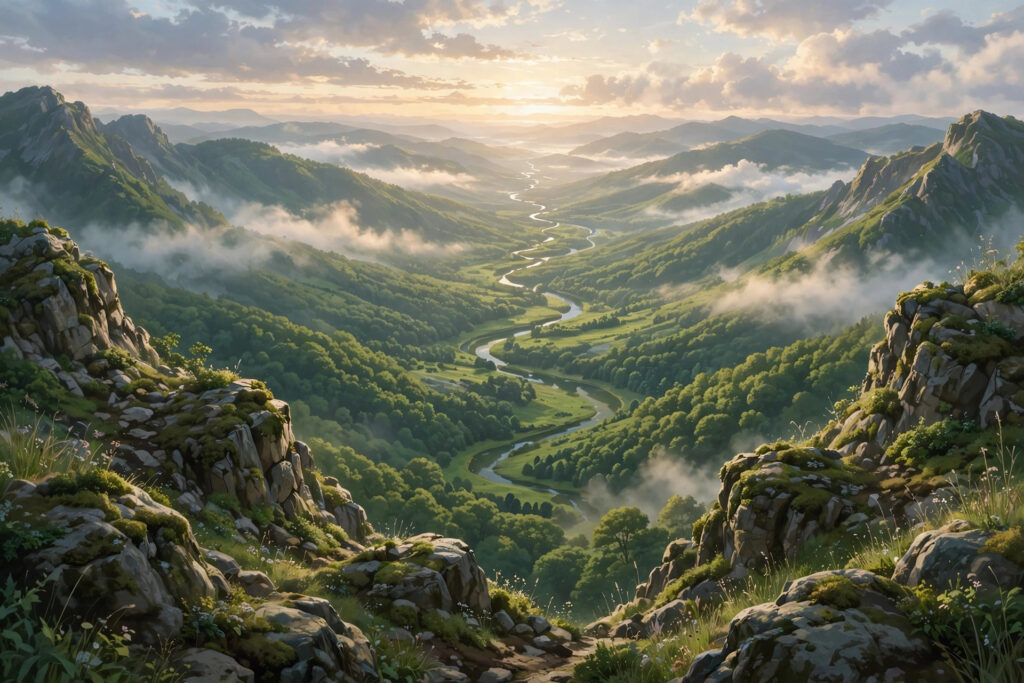
A green mountain is one of the most hopeful mountain dreams you can have. Green is the colour of life, growth, rain, and freshness. A mountain covered in grass, trees, or plants looks alive, welcoming, and full of promise. In Islamic dream interpretation, green is generally associated with goodness, faith, prosperity, and blessing, and when that green covers a mountain, the meanings come together in a hopeful way.
Seeing a green mountain can suggest a strong and good person in your life, a period of growth, an increase in provision, or a goal that will bring benefit not just to you but to others as well. It can also suggest that a difficulty you have been facing has a good side you have not seen yet — like a mountain that looks hard from a distance but turns out to be covered in soft green slopes when you get closer. For someone who has been praying for relief, a green mountain can feel like a sign of hope: the hard thing is still there, but it is alive, and something good is growing on it.
If you were walking on the green mountain, sitting on its grass, or looking at it from a beautiful valley, notice the peace in the dream. Dreams that leave you feeling peaceful are worth trusting as a general encouragement, even if you cannot pin down a single meaning. A green mountain dream is often a good dream to thank Allah for. It does not guarantee a specific outcome, but it is the kind of dream that most interpreters would read with optimism, and the kind that can give you the patience to keep going.
Seeing a Snow-Covered Mountain in a Dream
A mountain covered in snow looks beautiful, but it also feels cold, distant, and difficult to climb. That mixture is often the key to the meaning. Snow can stand for purity and stillness, but it can also stand for coldness, delay, or a matter that has gone quiet for a while. A snow-covered mountain in a dream can therefore have more than one reading, and the feeling of the dream helps you choose between them.
If the snow mountain looked bright, clean, and majestic, and you felt awe rather than fear, it can be read as a sign of a high and honourable matter — a great person, a noble goal, or a position of dignity. Snow on a high peak is natural; it belongs there. In the same way, some goals are meant to be high and take time. The dream may be telling you that what you are aiming for is worthy, even if it feels far away and cold at first.
If the snow felt bitter, the wind was harsh, and you felt frozen or unable to move, the meaning may lean more towards delay or difficulty. Perhaps a matter you are waiting on has gone cold — a reply that has not come, a person who has become distant, a plan that is paused for winter. That does not mean the matter is dead. Snow melts. A mountain that is white in winter can be green again in spring. If your dream had that cold feeling, take it as a picture of a waiting time, not a finished story. Keep warm, in the practical sense: keep in touch with the people who matter, keep your plans alive, and do not assume that silence means rejection.
Some people dream of snow falling on a mountain, or of a mountain that is half snow and half green. That half-and-half picture is worth noticing. It may reflect a situation that is partly hopeful and partly difficult, or a person who is kind in some ways and distant in others. Life is often like that — not all green, not all snow — and the dream may simply be showing you the mixture honestly.
Seeing a Rocky or Dark Mountain in a Dream
A rocky, bare, or dark mountain feels very different from a green one. There is no softness to it. The slopes are sharp, the colour is grey or black, and the whole shape can feel threatening. If that was your dream, it is natural to wonder whether it is a bad sign. The honest answer is that it leans towards difficulty, but difficulty is not the same as doom.
A dark or rocky mountain is often understood as a hard and stubborn matter, a difficult person, or a period of hardship. It can point to a person who is harsh, a task that will need real strength, or a situation where you will not get much softness or help from others. If you have been dealing with someone who feels like a wall — someone who will not listen, will not bend, and will not change their mind — a rocky mountain may be the picture your mind chose for them.
But there is a second side to rock. Rock is also strong. A rocky mountain does not crumble easily. If you were standing on it firmly, or you managed to climb it despite the sharp stones, the dream may also be about your own toughness. You may be harder to break than you think. And if the rocky mountain was in the distance and you were simply looking at it, it may be a warning to prepare — to save, to plan, to be patient — rather than a sign that harm is coming. Preparation is something you can do. Fear is not the only response to a dark mountain. Steadiness is another one.
A Mountain Moving or Shaking in a Dream
Mountains are supposed to stay still. That is the whole point of them. So when a mountain moves, shakes, or trembles in a dream, it feels deeply wrong, and people often wake up shaken by it. This is an uncommon dream, and it usually points to something that feels like it should be solid but is not — a big change, a shock, or a fear that the foundations of your life are shifting.
In general terms, a shaking mountain can be linked with a great disturbance: a change in leadership, a big event in a community, a family crisis, or a personal shock that affects everything around it. It can also reflect a time when a person you thought was unshakeable — a parent, a leader, a spouse — is going through their own difficulty, and you are feeling the tremor. If the mountain shook but did not fall, that detail matters. It suggests disturbance without destruction — a scare, a test, a difficult period that passes without bringing everything down.
If the mountain moved from its place, or split apart, the dream may feel more serious. Classical interpreters sometimes linked a moving mountain with the death or fall of a great person, or with a major upheaval. That is a heavy reading, and it should be handled with great care. Do not take a single dream as news about a specific person’s death or a coming disaster. Dreams are not newspapers. A mountain moving in your dream is more safely understood as a picture of how unstable things feel to you right now, and as a prompt to turn to prayer, to check on the people you love, and to make sure your own foundations — your faith, your family, your honesty — are firm. If you woke up frightened, say a short prayer for protection, give a little charity if you can, and do not spend the day looking for disaster. A dream like this is a reason to be thoughtful, not a reason to live in fear.
Descending or Coming Down from a Mountain
Coming down from a mountain is easy to misread. People often assume that going down must be a bad sign — as if you are losing height, losing status, or going backwards. But that is not always how it works in a dream. Sometimes coming down is exactly what you are supposed to do. You climb to see clearly, and then you come down to live your life with what you learned. A descent can mean returning to normal life after a high point, finishing a task, or stepping down from a position with dignity.
If you came down slowly and safely, with a clear path, this is often read as a good sign — a matter coming to a peaceful end, a responsibility being completed, or a return to ease after effort. It can also mean humility: you reached a high place, and now you are coming back down to earth, ready to be useful to the people around you. That is a healthy picture, not a sad one.
If the descent was frightening — you were sliding, slipping, or running down out of control — the meaning shifts. That kind of dream often reflects a loss of control, a fall from a position, or a worry that things are moving too fast in the wrong direction. It can also reflect a change you did not choose: a job ending, a role changing, a move you did not want. If that fits your life, the dream may be showing you the fear rather than the fact. You may still be able to slow the descent by making a clear plan, asking for advice, or taking one step at a time instead of sliding all at once.
Notice, too, whether you came down to somewhere good — a village, a home, a green valley, your family waiting below. If you did, the descent may be a homecoming, not a failure. The top of a mountain is a wonderful place to visit, but nobody lives there. Coming down can mean coming back to the people and the life that matter most.
Seeing a Mountain in the Distance
Sometimes the mountain in the dream is far away. You can see it clearly on the horizon, but you are not climbing it, and you are not standing at its foot. You are simply looking at it from a distance. This is a quieter dream than the climbing dreams, but it can be just as meaningful.
A distant mountain often stands for a goal that is still far off, a matter that belongs to the future, or a person of high rank who is not yet part of your daily life. It can be a picture of ambition that has not yet turned into action. You can see where you want to go, but you have not started walking yet. If the distant mountain looked beautiful and drew you towards it, that may be encouragement to start — to take the first small step, to make a plan, to stop waiting for the perfect moment.
If the distant mountain looked threatening, or you felt that it was watching you, or you were afraid it would come closer, the meaning may be about a worry that is still far away but already casting a shadow. Perhaps you are anxious about an exam months from now, a decision you will have to make next year, or a change you can see coming but cannot control yet. The dream may be showing you that the worry is taking up space in your mind even though the event itself is still distant. That is useful to notice. It gives you a chance to put the worry back in its place — to plan for the future without living in it today.
Sitting on a Mountain or Resting There
Not every mountain dream is about climbing. Some people dream that they are simply sitting on a mountain — resting on a rock, looking out over a valley, eating, talking with someone, or just being still. This is a calm dream, and its meaning is usually calm as well.
Sitting on a mountain can suggest a position of honour or security, a time of rest after effort, or a period of reflection. You have climbed, or you have been given a high place, and now you are taking time to look around and think. It can also suggest that you are in a strong position in a matter — you have the high ground, in the gentle sense. You can see clearly, you are not rushed, and you have time to decide well.
If you were sitting with someone else — a parent, a spouse, a friend, a teacher — think about what that person means to you. Sharing a high, peaceful place with someone can reflect trust, closeness, or a shared goal. If you were sitting alone and felt peaceful, that may reflect a need for solitude and reflection that you have not been giving yourself in waking life. If you were sitting alone and felt lonely or exposed, it may reflect the isolation that can come with a high position or a big responsibility. Even at the top, company matters, and the dream may be reminding you not to carry everything alone.
A Cave in a Mountain
A cave in a mountain is a special image, and it carries its own feeling. A cave is shelter. It is hidden, quiet, and protected from the weather outside. In Islamic history, a cave also carries a deeply meaningful association — the Cave of Hira, where revelation began — and for many Muslims, a cave in a dream can bring a feeling of spiritual retreat, safety, or turning towards Allah. This article does not claim that every cave dream is about that event. But the feeling of shelter and seclusion is part of what a cave means in a dream.
Seeing a cave in a mountain, or entering one, is often understood as a sign of safety, refuge, or a place to think and regroup. It can suggest that you need a period of quiet — time away from noise, from other people’s demands, from the rush of daily life — to listen to yourself and to pray. It can also suggest protection: a difficulty is outside, but you have a safe place within it. If you hid in the cave from danger in the dream, that may reflect a wish for safety in a situation that feels threatening. If you entered the cave willingly and felt peaceful, it may reflect a spiritual longing — a wish to be closer to Allah, to read, to reflect, or to start again with a clearer heart.
If the cave was dark and frightening, or you felt trapped inside it, the meaning may be different. A dark cave can reflect a feeling of being stuck, hidden, or cut off from others. It can also reflect a secret, or a part of your life you have been keeping out of sight. Notice which feeling was stronger: shelter, or confinement. That feeling is usually the best guide to which reading fits your dream.
A Mountain Collapsing, a Landslide, or Rocks Falling
A mountain collapsing or a landslide in a dream is frightening, and it is natural to wake up worried. Rocks falling, the ground giving way, dust in the air, the solid thing you trusted suddenly breaking apart — it is a picture of sudden change. In general terms, this kind of dream is often linked with a great person losing power, a strong situation breaking down, or a sudden shock in a community or family. It can also reflect a personal feeling: something you thought was permanent has changed, and you are still catching up with that fact.
But again, the details matter. Did the collapse happen far away, where you could watch it safely? That may reflect a change you are observing rather than suffering — a company restructuring, a leader stepping down, a family situation shifting — something big, but not something that has knocked you down. Did rocks fall near you, and did you have to run? That may reflect a more personal sense of danger or urgency, and a need to move quickly or protect yourself in a situation. Did you survive, find shelter, or help others? That part of the dream may be the most important. Survival in a frightening dream is often a hopeful sign — it suggests resilience, and an ability to get through a shock even when it comes suddenly.
Do not take a landslide dream as a prediction of a real landslide, or of a specific disaster. Dreams use dramatic pictures to show feelings. A mountain collapsing can be the mind’s way of picturing a loss of trust, a broken promise, a business failing, or a relationship ending — all of which can feel like the ground giving way. If you have recently had a shock like that, the dream may simply be processing it. Give yourself time, talk to someone you trust, and do not make big decisions while you are still in the dust of the shock.
Climbing a Mountain with Someone Else
Who you climb with can change the meaning of a climbing dream quite a bit. If you climbed with your spouse, it may reflect a shared goal — building a home, raising children, saving for something, or getting through a hard time together. The way you climbed together matters. Did you help each other? Did one of you go ahead and wait for the other? Did you argue about the path? Those details often mirror how you work together in real life, and the dream can be a gentle way of showing you what is working and what needs attention.
Climbing with a parent can reflect a wish for their approval, their guidance, or their strength. It can also reflect a family goal — something you are trying to achieve for the family, or a difficulty the family is facing together. Climbing with a friend can reflect loyalty and shared effort. Climbing with a stranger, or with a guide you did not know, can reflect help that is coming from an unexpected place, or a need to trust someone new.
If someone in the dream pushed you, pulled you down, or left you behind on the mountain, do not rush to blame that person in real life. Dreams sometimes use a familiar face to stand for a feeling rather than for the person themselves. A friend who left you behind in the dream might stand for a feeling of being left behind in general, rather than for anything that friend actually did. Still, if the dream leaves you with a clear, uneasy feeling about a real relationship, it is worth paying attention to that feeling in a calm way — not as an accusation, but as a question to explore.
A Mountain with Water, a River, or a Valley
Mountains rarely appear alone in dreams. Often there is water nearby — a river running down from the mountain, a lake at its foot, rain falling on its slopes, or a green valley spread out below it. Water in dreams is often linked with life, provision, knowledge, and mercy, and when it appears with a mountain, it usually softens the meaning.
A river flowing from a mountain can suggest that a great person or a difficult matter will bring benefit to others — like water that starts high up and flows down to the fields below. It can also suggest that provision or knowledge will reach you from a high or unexpected source. A lake at the foot of a mountain can suggest calm after effort, or a place of rest. Rain on a mountain can suggest mercy and relief coming to a hard situation.
A valley between mountains is also worth noticing. A valley is sheltered, lower, and often greener than the peaks. Dreaming of a valley between mountains can suggest safety between two great matters, or a period of ease between difficulties. If you were walking through a valley and felt peaceful, that may reflect a time in your life when things have settled, even if big matters still stand on either side. The mountains have not gone away, but you have found a way to live well between them.
Seeing a Mountain at Sunrise or Sunset
The time of day in a mountain dream can add another layer. A mountain at sunrise, with light spilling over its top and the sky turning gold, is a hopeful picture. Sunrise stands for a new beginning, and a mountain at sunrise can suggest that a new phase is starting — a fresh opportunity, a new understanding, or a difficulty that is beginning to lift. If you woke up feeling hopeful after a sunrise mountain dream, that hope is worth holding on to.
A mountain at sunset can feel more bittersweet. Sunset stands for an ending, or for a day coming to a close. A mountain at sunset might reflect the end of a phase — a job ending, a chapter closing, a person leaving, or a goal being completed. That is not necessarily sad. Endings can be peaceful, especially when the light is beautiful. If the sunset felt calm and golden, the dream may be about completion and gratitude. If it felt dark and cold, with the light fading fast, it may reflect a worry that time is running out for something you care about. Either way, the mountain itself remains. The light changes, but the mountain does not disappear, and that steadiness can be a comfort in itself.
A Small Hill or a Mountain That Looks Small
Not every mountain in a dream is huge. Sometimes people dream of a small hill, or a mountain that looks smaller than it should, or a mountain they can walk over without much effort. This kind of dream often reflects a matter that once felt large but is becoming smaller — a fear that is shrinking, a problem that is turning out to be manageable, or a goal that is closer than you thought.
If you dreamed of a small mountain and felt relieved, take that relief seriously. It may be your mind telling you that you have been overestimating a difficulty. Many worries look like mountains from far away and turn out to be hills when you get closer. If you dreamed of a mountain shrinking, or of climbing it in a few easy steps, it can be a hopeful sign that a burden is lifting, or that you are growing stronger in relation to it. The mountain has not changed — you have.
What a Mountain Dream Can Mean for Different People
A mountain dream does not mean the same thing for everyone, because the mountain in your life is not the same as the mountain in someone else’s. A student, a job seeker, a married person, and a sick person can all dream of the same mountain and take something different from it. Here are a few common situations, to help you place your own dream in context.
For a student, a mountain often stands for study itself — an exam, a degree, a subject that feels hard, or a future that feels uncertain. Climbing steadily can reflect progress in learning, even when it feels slow. Standing on the top can reflect the hope of graduating or succeeding. Struggling to climb can reflect the pressure of exams or the feeling of falling behind. If you are a student and you dreamed of a mountain, ask yourself what part of your studies feels like the climb right now, and what would make the path clearer — better notes, a teacher’s help, a study partner, or simply more rest.
For someone looking for work, a mountain can stand for the job search itself — the applications, the interviews, the waiting, the feeling of being small in front of big companies. A green mountain can be a hopeful sign in this context, suggesting that provision will come, even if the way is slow. A mountain blocking the path can reflect a specific obstacle — a lack of experience, a missing qualification, a delay in a reply. If the dream showed you climbing, keep applying, keep learning, and keep asking for help. The climb in the dream may be mirroring the persistence you need in real life.
For a married person, a mountain can stand for the marriage itself, or for a shared responsibility such as a home, children, or money. Climbing together can be a good sign of partnership. A mountain between you and your spouse in a dream can reflect a distance that has grown between you — not necessarily a break, but a sense that something stands in the way of closeness. If that feels true, the dream may be a prompt to talk, gently and honestly, rather than to let the mountain grow larger through silence.
For someone who is sick, or caring for someone who is sick, a mountain can stand for the illness or the treatment — something heavy, slow, and hard to move. A green or peaceful mountain in this context can be a source of comfort, a reminder of patience and hope. A steep, dark mountain can reflect the fear and tiredness that come with illness. If this is your situation, be kind to yourself about the dream. You do not need to read it as a medical prediction. Take from it what helps — the reminder to be patient, to rest, to ask for help — and leave the rest.
For a traveller, or someone thinking of moving, a mountain can stand for the journey itself, or for a new place that feels unfamiliar and high. A mountain in the distance can reflect a move you are considering but have not yet made. A mountain you have already crossed can reflect a journey completed, or a stage of life you have moved past. And for someone who has recently lost a loved one, a mountain can stand for grief itself — large, immovable, and always there on the horizon — and for the slow climb of learning to live with it. If grief is part of your life right now, a mountain dream may simply be your heart picturing what you are carrying. You do not need to solve it. You only need to keep walking, one step at a time.
What Classical Islamic Dream Literature Says About Mountains
It is worth pausing here to say something about the sources. In the Islamic tradition, dream interpretation has a long history, and the names most people have heard are Ibn Sirin and Imam Jafar Sadiq. Their names are linked with books and sayings about dreams that have been passed down, studied, and quoted for centuries. When modern articles — including this one — talk about what a mountain means in Islamic interpretation, they are drawing in general terms on that tradition: the idea that a mountain can stand for a great person, a high rank, a firm character, or a large obstacle.
That general link is widely reported. What is harder is to pin down a single, exact quotation with a verified chain and a numbered reference for every specific scenario in this article. The books attributed to these scholars have been copied, translated, and added to over many generations, and not every saying that circulates with their name can be verified to the same standard. That is why this article does not invent a hadith, does not give a verse number it cannot verify, and does not present a numbered citation as if it were certain when it is not. To do that would be misleading, and dream interpretation deserves better than made-up authority.
What can be said safely, and generally, is this: the classical literature treats mountains as symbols of greatness and firmness. A large mountain is linked with a large matter or a great person. A mountain that is easy to climb is treated more hopefully than one that is impossible to climb. A green and fruitful mountain is treated more hopefully than a barren and rocky one. Standing on a mountain is linked with high rank and honour. Falling from one is linked with a loss of rank or a setback. These are broad patterns, not precise predictions, and they are best used as a starting point for reflection, not as a fixed verdict on your life.
There is also an important distinction in Islamic teaching about dreams themselves. Not every dream is a message. Some dreams come from our daily thoughts, worries, and hopes. Some come from what we ate, how we slept, or what we watched before bed. And some, by Allah’s mercy, are good dreams that bring comfort or guidance. The scholars have long said that a good dream can be shared and thanked for, and a frightening dream should not be given more weight than it deserves. That is a helpful balance to keep in mind with a mountain dream. If it was good and left you peaceful, thank Allah and take the encouragement. If it was frightening, do not let it rule your day. Pray, seek protection, and carry on with the practical steps in front of you.
If you want to go deeper, the best next step is not to collect more and more specific interpretations from the internet, where many are copied without checking. It is to read the classical works through a trusted teacher or a reliable edition, and to ask a knowledgeable person you trust if a dream is weighing on you. A short conversation with someone who knows both the tradition and your situation is worth more than a hundred web pages.
What to Do After Dreaming of a Mountain
A dream is only useful if it leads to something good in your waking life. Here are some simple, practical steps you can take after a mountain dream, whether it felt hopeful or frightening. None of them requires special knowledge. All of them are things you can do today.
- Write down the dream while you still remember it. Note the mountain itself, what you were doing, who was with you, how you felt, and how the dream ended. Dreams fade quickly, and the details that matter most are often the first ones you forget. A few lines in a notebook or on your phone are enough.
- Thank Allah for a good dream. If the dream was peaceful, hopeful, or beautiful, take a moment to be grateful. Gratitude does not mean you are claiming the dream must come true. It means you are receiving the comfort it gave you with a thankful heart.
- Seek protection after a frightening dream. If the dream scared you, do not repeat it to everyone you meet, and do not spend the day expecting something bad. Say a short prayer for protection, as you would after any bad dream, and turn your attention to the day in front of you. Fear grows when you feed it with retelling. Calm grows when you return to normal, useful action.
- Ask yourself what the mountain is in your life. Is there a goal, a problem, a person, or a decision that feels like a mountain right now? Name it clearly, in one sentence, if you can. “My mountain is the exam next month.” “My mountain is the debt.” “My mountain is the disagreement with my brother.” Naming it takes it out of the fog and makes it something you can plan for.
- Break the climb into small steps. A mountain is climbed one step at a time, not in one leap. If your mountain is a big task, write down the smallest next step you can take today — one phone call, one page of study, one honest conversation, one application. Then take it. Small steps are how real mountains are climbed.
- Ask for help if you need it. Climbers use ropes, guides, and companions for a reason. If your mountain feels too steep to climb alone, that is not a failure. Ask a family member, a friend, a teacher, or a professional for help. In a dream, a guide on a mountain is a good sign. In life, asking for guidance is a strength.
- Be patient with a waiting time. If your dream was of a distant mountain, or a snow-covered one, or a mountain blocking the path with no way through yet, the practical step may be patience rather than pushing. Some doors open with time, prayer, and a change in circumstances. Use the waiting time well — prepare, learn, save, pray — so that when the way opens, you are ready.
- Check your intention. If the mountain in your dream was about ambition — a high position, a big success — take a quiet moment to check why you want it. Is it for your family, for a good life, for the sake of Allah, or for pride and showing off? A mountain climbed for a good reason feels different from one climbed only to look down on others. A clear intention makes the climb steadier.
- Give a little charity if you can. Charity is a simple, practical way to respond to any dream that leaves you thoughtful or uneasy. It turns worry into action, and it is a reminder that provision and protection come from Allah, not from our own strength alone.
- Do not make a big decision on a dream alone. A dream can prompt you to think, to pray, and to seek advice. It should not be the only reason you quit a job, end a relationship, spend a large sum of money, or make any other life-changing choice. If a dream has left you with a strong feeling about a decision, take that feeling to prayer, to the Quran, and to trusted advice — and then decide with a clear mind.
Common Mistakes When Interpreting a Mountain Dream
There are a few mistakes people often make with a dream like this, and it is worth naming them so you can avoid them. The first is taking one symbol and treating it as a fixed prediction. A mountain does not mean one thing for every person, every time. The same green mountain can mean a good person for one dreamer and a hopeful goal for another. The interpretation has to fit your life, not just a list.
The second mistake is ignoring how you felt. Two people can dream of the same steep climb, and one wakes up feeling determined while the other wakes up feeling defeated. That difference matters. Your feeling is part of the dream, not an extra. If you felt peace, trust that peace. If you felt fear, do not pretend you did not. Name the feeling, and ask what in your life is producing it.
The third mistake is reading a frightening dream as a curse or a warning of certain harm. A falling dream, a collapsing mountain, a shaking peak — these are frightening pictures, but they are pictures, not announcements. They often show a fear you already carry, or a shock you have already had, rather than a new disaster on its way. Treat them with seriousness and prayer, but not with panic.
The fourth mistake is the opposite: reading a good dream as a guarantee. Standing on a mountain top does not mean a promotion is certain, or that a wish will come true exactly as you imagined. It is encouragement, not a contract. The best response to a good dream is gratitude and steady effort, not sitting back and waiting for the top to come to you.
And the fifth mistake is forgetting the rest of the dream. A mountain with a river is not the same as a mountain alone. A mountain at sunrise is not the same as a mountain in a storm. A mountain you climb with your spouse is not the same as a mountain you climb alone. When you look for a meaning, look at the whole picture, not just the biggest object in it.
Frequently Asked Questions About Seeing a Mountain in a Dream
1. Is seeing a mountain in a dream a good sign or a bad sign?
It can be either, and most often it is somewhere in between. A mountain is a large symbol, so its meaning depends on what kind of mountain it was and what you were doing with it. A green, peaceful mountain, a steady climb, or standing safely on the top are generally read as good signs — they point towards strength, honour, growth, or success after effort. A dark, rocky, or collapsing mountain, a frightening fall, or a mountain that blocks your path with no way through tends to point towards difficulty, a burden, or a stubborn obstacle. But even the difficult versions are not a final verdict. They are a picture of how something feels right now, and feelings can change as circumstances change and as you take practical steps. The most useful question is not “good or bad?” but “what is the mountain in my life, and what is the next small step?”
2. What does it mean to dream of climbing a mountain and reaching the top?
Reaching the top of a mountain in a dream is generally understood as a hopeful sign. It often points to achieving a goal you have worked for, gaining a high position or respect, or finding clarity after a period of confusion. It can reflect success in studies, work, a personal project, or a spiritual effort. How you felt on the top matters: peace and gratitude suggest contentment, while fear of the height or loneliness up there may reflect the pressure that comes with a new responsibility. If you reached the top easily, the task ahead may turn out smoother than you expected. If you reached it after a hard climb, the dream may be honouring the effort you have already put in. Either way, take it as encouragement to keep going, and remember to stay humble once you get there.
3. What does falling from a mountain in a dream mean in Islam?
Falling from a mountain is usually linked with a setback, a loss of position, or a fear of failure, rather than with a specific event that will happen. It can reflect a change you have already felt — a job lost, a relationship strained, confidence shaken — or a worry that something steady in your life is no longer steady. What happened after the fall is important: landing safely or surviving is often read hopefully, as a sign of recovery and resilience. Waking up before landing is very common and does not mean harm was about to happen. If this dream frightened you, pray for protection, do not retell it anxiously to everyone, and look at the practical facts of your life. A fall in a dream is a reason to be careful and steady, not a reason to expect disaster.
4. What does a green mountain mean in a dream?
A green mountain is one of the most positive mountain dreams. Green in Islamic dream interpretation is generally associated with life, faith, growth, and blessing, and a mountain covered in green suggests something strong that is also alive and fruitful. It can point to a good and strong person who supports you, a period of growth or increase in provision, or a goal that will bring benefit to you and to others. It can also suggest that a difficulty has a hopeful side you have not seen yet. If you felt peaceful looking at the green mountain, or walking on it, that peace is part of the meaning. Thank Allah for a good dream like this, and let it give you patience for the climb that is still ahead.
5. Does dreaming of a mountain mean I will face a big problem?
Not necessarily. A mountain can stand for a problem, but it can also stand for a goal, a strong person, a high position, or your own strength and patience. Many people dream of mountains when they are thinking about something big, even when that something is good — a wedding, a new job, a degree, a house, a business. The dream may simply be showing you the size of the matter in your mind, not warning you that it will go wrong. To tell the difference, look at the details: was the mountain green or dark, was the path clear or blocked, were you climbing steadily or falling, and did you wake up feeling hopeful or afraid? A mountain dream is best treated as a prompt to reflect and prepare, not as a prediction that a problem is coming.
6. Should I tell others about my mountain dream?
That depends on what kind of dream it was. If it was a good dream — peaceful, hopeful, beautiful — sharing it with someone you trust, such as a family member or a knowledgeable friend, is generally fine, and can be a way of sharing gratitude. If it was a frightening dream — a fall, a collapse, a shaking mountain — the traditional advice is to be more careful: pray for protection, do not dwell on it, and do not spread it around as if it were news. You can still talk to one trusted person if the dream is weighing on you, especially if you need advice about a real situation in your life. But there is no need to tell everyone, and there is no need to keep searching for scarier interpretations online. A dream is guidance for reflection, not a public announcement, and the best use of it is usually quiet: prayer, a small practical step, and a return to your day.
Final Thoughts
If you dreamed of a mountain, you dreamed of something big — and big things in life deserve time, patience, and a clear head. A mountain can be a goal, a person, a difficulty, or a strength. It can be green and hopeful, or dark and demanding. It can be a climb you are already on, a top you have already reached, a fall you are afraid of, or a distant peak you have not yet started towards. The dream does not decide which one it is for you. Your life does, and the small details of the dream help you see your life a little more clearly.
So take the dream seriously, but take it gently. Write it down. Thank Allah if it was good. Pray for protection if it was frightening. Name the mountain in your life, if you can. Take one small step towards it, or around it, or through it today. Ask for help if the climb is steep. Rest if you are tired. And remember that mountains, for all their size, are climbed the same way by everyone: one step, then another, then another — until the top, which once looked impossible, is suddenly under your feet.
Disclaimer: Dream interpretation is guidance, not certainty. The meanings in this article are general interpretations drawn from classical Islamic dream literature in broad terms, and from the common symbolism of mountains. They are not predictions, medical advice, or religious rulings, and they do not replace personal prayer, reflection, and advice from a knowledgeable person you trust. Every dream depends on the dreamer’s life, feelings, and circumstances, and only Allah knows its true meaning and what the future holds.
