Some dreams fade before you have even opened your eyes. Others stay with you all day, quietly sitting at the back of your mind while you get on with work, make breakfast, or drive the kids to school. A dream about the Quran is almost always the second kind.
Maybe you saw the Quran resting open on a stand in a quiet room. Maybe you were holding it close to your chest. Maybe someone handed it to you, or you heard a beautiful recitation and woke up with the sound still in your ears. Whatever the exact scene was, it probably left you with the same feeling: this was not an ordinary dream. It felt calm, or heavy, or hopeful — and now you want to know what it meant.
That is a very human response, and a very Islamic one too. Muslims have always paid attention to dreams, not because every dream is a message, but because some dreams carry comfort, encouragement, or a gentle nudge back towards Allah. The Quran itself tells us about dreams that mattered — like the dream of Prophet Yusuf, peace be upon him, who saw eleven stars, the sun and the moon bowing to him. That dream was real, and it was part of a much bigger story that unfolded over many years.
But here is the honest starting point for this whole article: a dream about the Quran is a beautiful thing to experience, and it is worth reflecting on, but it is not a new revelation. No dream, however vivid or moving, can add to the Quran or change what the Quran and the Sunnah already teach us. A good dream can encourage you, comfort you, and remind you of what you already know is true. It cannot tell you to do something the Quran forbids, or promise you something Allah has not promised. Keeping that balance in mind will help you read everything that follows in the right way.
In this article, we will walk through it slowly and honestly. We will look at how Islam understands dreams in general, why the Quran appears in dreams as a symbol of guidance and light, what the most common scenarios are traditionally understood to point towards, what classical Islamic dream literature says in general terms, and — most importantly — what you can actually do after a dream like this. There are no invented meanings here, no made-up hadith, and no claim that one dream means exactly one thing for every person. A dream is always shaped by the life of the person who dreamed it.
If you woke up from a dream about the Quran feeling peaceful, take that peace seriously. If you woke up feeling worried, take that seriously too — not as a bad omen, but as a sign that your heart might be asking for something: more closeness to the Quran, more steadiness in prayer, more honesty with yourself. Either way, this dream is a good reason to sit with the Quran a little longer today than you did yesterday.
Quick Summary
If you are short on time, here is the heart of it. A dream about the Quran is traditionally understood in Islamic thought as a positive and hopeful dream. Because the Quran is guidance, light, and the speech of Allah, seeing it in a dream is generally associated with guidance, knowledge, comfort, and a reminder to turn back to Allah. The exact feeling and setting of the dream matter more than any single symbol, and the most useful response is simple: be grateful, reflect on your relationship with the Quran, and let the dream encourage you towards good deeds — not fear or superstition.
- Generally positive: Seeing the Quran in a dream is traditionally understood as a good and hopeful sign, linked to guidance, knowledge, and closeness to Allah.
- Context matters most: Reading it, holding it, receiving it as a gift, or hearing it recited each carry a slightly different shade of meaning, shaped by how the dream felt.
- Dreams are of three kinds in Islam: a true dream from Allah, a dream from a person’s own thoughts and daily life, and a frightening dream from Shaytan.
- No dream is revelation: A dream can comfort and encourage you, but it never overrides the Quran and Sunnah, and it should never be treated as a new religious ruling.
- The best response is practical: Thank Allah, recite or read a little Quran, reflect honestly on your life, and take one small step towards the Quran — even a few verses a day.
- If the dream was unsettling: Do not panic or spread it around. Seek refuge in Allah, pray, and speak about it only to someone knowledgeable and trustworthy if you need guidance.
Dreams in Islam: The Three Kinds of Dreams
Before we talk about the Quran in a dream, it helps to understand how Islam talks about dreams in general. This is where a lot of confusion starts, because people often treat every dream as if it were a message, or dismiss every dream as meaningless. The Islamic view sits in the middle, and it is much more balanced than either extreme.
There is a well-established narration in Sahih Muslim 2263 that describes three kinds of dreams. The first is a true dream, a glad tiding from Allah. The second is a dream that comes from what a person has been thinking about during the day — their worries, hopes, memories, and the things that filled their mind before sleep. The third is a frightening dream from Shaytan, meant to disturb and upset a person.
That simple framework is genuinely helpful, because it gives you a way to think about your own dream without over-reading it. Not every dream about the Quran is automatically a true dream from Allah. It might be, and many people who have such a dream feel in their hearts that it was something special. But it could also be a reflection of your own life: perhaps you have been thinking about the Quran a lot lately, listening to recitation, trying to memorise a surah, or feeling guilty that you have drifted away from it. In that case, the dream is your own heart showing you what is already on your mind. That does not make it meaningless — far from it. A dream that mirrors your own longing for the Quran is still telling you something true about yourself.
And then there is the third kind. If a dream about the Quran felt frightening, confusing, or dark — for example, if the Quran was being disrespected in the dream, or you felt fear while holding it — that does not automatically mean something bad will happen to you. Frightening dreams are, in the Islamic understanding, from Shaytan, and their purpose is to make you anxious. The response to such a dream is not to panic or to go looking for a bad interpretation, but to seek refuge in Allah, to pray, and to let it go. A scary dream has no power over your life unless you give it power by obsessing over it.
So how do you tell which kind your dream was? There is no checklist that gives a certain answer, and any honest writer will tell you that. But there are a few gentle signs people often notice. A true dream, as described in Islamic tradition, tends to leave a feeling of calm, clarity, and goodness — even if you cannot explain why. It feels clean. It does not leave you confused or afraid, and it does not push you towards something haram or strange. A dream from your own thoughts often connects clearly to something you did, saw, or worried about that day. And a dream from Shaytan tends to feel chaotic, frightening, or disturbing, and it leaves you unsettled in a way that does not bring you closer to Allah.
Most dreams about the Quran, as people describe them, fall into the first two categories. They feel peaceful, or they clearly connect to a person’s real relationship with the Quran. That is worth remembering before you go searching for a detailed meaning for every object in the dream. The feeling of the dream is often the most honest part of it.
It is also worth saying plainly: in Islam, dreams are a form of glad tidings and encouragement for a believer, not a source of law. A dream can strengthen your heart, but it cannot tell you that something forbidden is now allowed, or that something allowed is now forbidden. It cannot tell you to leave your family, quit your job, or make a huge life decision on its own. Big decisions in Islam are made with the Quran, the Sunnah, prayer, consultation with trustworthy people, and sound thinking — not with a single night’s dream. If a dream seems to push you towards something that contradicts clear Islamic teaching, that is a strong sign to step back and not follow the dream.
This is a freeing way to think about dreams, once you get used to it. You do not need to be afraid of your dreams, and you do not need to treat every dream as a puzzle you must solve perfectly. You can receive a beautiful dream with gratitude, reflect on it, and then get on with living a good life — which is, in the end, what the dream was pointing you towards anyway.
The Quran as Guidance and Light
To understand why seeing the Quran in a dream feels so meaningful, you have to start with what the Quran is. For a Muslim, the Quran is not just a book on a shelf. It is the speech of Allah, revealed as guidance for humanity. It is the book that tells us who Allah is, how to live, how to treat one another, and how to find our way back when we get lost.
The Quran describes itself in exactly those terms. In Surah Al-Baqarah 2:2, Allah says: “This is the Book about which there is no doubt, a guidance for those conscious of Allah.” That is a powerful sentence to sit with. A book about which there is no doubt. A guidance for those who are conscious of Allah — those who are mindful, who care about doing right, who want to live with Allah in mind. When you see the Quran in a dream, you are seeing, in symbolic form, that guidance itself.
Another verse puts it just as clearly. In Surah Al-Isra 17:9, we are told: “Indeed, this Quran guides to that which is most upright.” The Quran does not just give information; it guides to what is most upright, most straight, most right. It points the way when life feels crooked or confusing. So a dream in which the Quran appears often feels like a reminder of that guidance — as if your heart is being shown the straight path again, gently, while you sleep.
That is why classical interpreters generally associated the Quran in a dream with knowledge, wisdom, and guidance. In the tradition of Islamic dream interpretation, the Quran is one of the most positive symbols a person can see. It is traditionally understood to point towards an increase in knowledge, a return to the straight path, relief from confusion, and closeness to Allah. It is not a symbol of fear or punishment in the way some other dream images can be. Even when the dream carries a warning — for example, if the Quran seemed neglected or distant in the dream — the warning itself is a form of guidance: a nudge to come back to the Quran before it is too late.
Think about it in everyday terms. If you are lost on a road at night and someone hands you a lamp, you do not spend hours analysing the lamp. You are grateful for the light, and you use it to find your way. The Quran in a dream works in a similar way. It is light in a dark place. It is direction when you feel directionless. It is a reminder that you are not alone and that guidance is available to you, right now, in a book you can open any day.
This also explains why dreams about the Quran often come at particular moments in life. People frequently report them when they are going through a difficult time, when they are trying to make an important decision, when they have drifted away from prayer or Quran reading and feel guilty about it, or when they have just started to take their faith more seriously. The dream arrives, in a sense, at exactly the moment when guidance is most needed. Whether you understand that as a true dream from Allah or as your own heart speaking to you in sleep, the message is similar: turn back to the Quran.
It is important to keep this grounded, though. The Quran in a dream does not mean you are suddenly a scholar, or that you have been given a special status, or that your sins are automatically forgiven. It means, in the traditional understanding, that guidance is near to you and that your heart is turned towards it. What you do with that nearness while you are awake is what matters most. A dream can open a door; only you can walk through it.
Common Scenarios: What People Most Often Dream About
No two dreams about the Quran are exactly the same, and that is exactly why it helps to look at the most common scenarios one by one. Each scenario below is described in the way classical interpreters generally associated it, and in the way ordinary Muslims have understood it over the centuries. Read the one that matches your dream, but also read the others — you may find that your dream was a mix of two or three of them, and that is completely normal. Dreams rarely fit into neat boxes.
A quick note before we start: these are traditional associations, not certainties. They are the kind of meanings that have been passed down in Islamic dream literature for a long time, and they are offered here so you can reflect, not so you can treat them as a fixed prediction. Your life, your intentions, and the feeling of the dream all shape what it means for you.
Reading the Quran in a Dream
This is one of the most common and most loved scenarios. You dream that you are sitting quietly and reading the Quran — perhaps fluently, perhaps slowly, perhaps with tears in your eyes. The words feel clear, and you understand them, or at least you feel their weight.
Traditionally, reading the Quran in a dream is understood as a very good sign. Classical interpreters generally associated it with guidance, knowledge, and an increase in understanding of the religion. If you were reading clearly and with ease, it is traditionally taken as a sign that your heart is open to guidance and that Allah is making the path easy for you. If you were reading and understanding the verses as you went, it is often understood as a sign of wisdom and of a heart that is receptive to truth.
For many people, this dream comes when they have been trying to build a habit of reading Quran daily, or when they have just returned to it after a long gap. In that case, the dream feels like encouragement: keep going, you are on the right track. It can also come when a person is facing a decision and looking for direction — the act of reading in the dream mirrors the act of seeking guidance in real life.
If you dreamed of reading the Quran but struggled with the words, stumbled, or could not read clearly, do not take that as a bad omen. Traditionally, that kind of dream is often understood as a gentle reminder rather than a warning — a sign that your connection with the Quran needs attention, and that you would benefit from reading more regularly, even a little each day, and from learning the meaning of what you read. The dream is not scolding you; it is showing you where the work is.
What matters most is how you felt while reading. Peace, focus, and tears of humility are all good signs in a dream. Confusion or frustration simply point to an area of your life where you might need more patience and more learning. Either way, the practical response is the same: pick up the Quran today, read a few verses with their meaning, and let that be the start of a steadier habit.
Holding or Carrying the Quran
Another very common dream is holding the Quran close — in your hands, against your chest, or carrying it carefully as you walk somewhere. There is something tender about this image, and people often wake up feeling protected, as if they were holding onto something precious.
In the traditional understanding, holding the Quran in a dream is associated with holding onto guidance, faith, and trust in Allah. It can suggest that you are carrying the Quran’s teaching with you in your life, or that you need to hold onto it more tightly during a difficult time. If you held it close to your chest, that closeness is often read as closeness of the heart — love for the Quran, and a desire to keep its guidance near you.
Carrying the Quran while walking somewhere can carry an extra shade of meaning. It is traditionally understood as a sign that you are carrying guidance with you on your journey through life, and that you are not walking alone. If the path in the dream was clear and easy, that is a hopeful image. If the path was difficult but you kept hold of the Quran, that too is hopeful — it suggests steadfastness, the quality of holding onto faith even when life is hard.
Sometimes people dream of holding the Quran but feeling that it is heavy. That heaviness is not necessarily a bad sign. The Quran is a weighty trust — it asks something of us. A dream in which it feels heavy can be a reminder that faith is not always light and easy, and that carrying it with sincerity takes effort. If that was your dream, take it as encouragement to carry it with patience, not as a sign that you are failing.
Receiving the Quran as a Gift
Being given the Quran as a gift in a dream is a beautiful image, and it is one that people remember for a long time. Perhaps a parent, a teacher, a friend, or a stranger handed it to you with both hands. Perhaps you did not know the giver, but the gift felt precious.
Traditionally, receiving the Quran as a gift is understood as a sign of guidance being offered to you, and of knowledge or blessing coming your way. It can be understood as an invitation: the door to guidance is open, and you are being invited to step through it. If the giver was someone you love and respect — a parent, a grandparent, a teacher — the dream may also reflect the love and concern that person has for your faith, or the good influence they have had on you.
If the giver was someone you do not know, classical interpreters generally did not treat that as a problem. An unknown giver in a dream is often simply part of the dream’s language — the focus is on the gift, not the giver. The gift itself is the point: guidance, freely given.
This kind of dream often comes at a turning point. People report it when they are thinking about changing their life, starting to pray regularly, learning more about Islam, or making a fresh start after a mistake. If that sounds like you, take the dream as encouragement to accept the gift — not by buying a new Quran and putting it on a shelf, but by opening the one you already have and reading it.
Hearing Quran Recitation in a Dream
Some people do not see the Quran in their dream at all — they hear it. A beautiful recitation fills the room, or a voice recites verses they know, or the sound of the Quran seems to come from everywhere at once. They wake up with the melody still in their mind, and sometimes with a feeling of peace they have not felt in a long time.
Hearing the Quran recited in a dream is traditionally understood as a very positive sign. Sound, in dreams, often represents a message reaching the heart, and the Quran’s recitation is the most beautiful message there is. Classical interpreters generally associated hearing recitation with glad tidings, comfort, and a reminder to listen — to really listen — to what Allah is saying.
If you recognised the verses being recited, it is worth thinking about what those verses mean in your life right now. You do not need to force a connection. Just sit with the verse, read its meaning in translation if you need to, and ask yourself honestly whether there is something in it that speaks to your current situation. Often, the verse you heard is the part of the dream that stays with you longest, and that is no accident.
If you did not recognise the verses, or the recitation was in a voice you did not know, that does not make the dream less meaningful. The feeling of peace that comes with hearing the Quran is itself a gift. Many people say this kind of dream helped them through grief, anxiety, or a period of feeling far from Allah. The sound of the Quran in a dream can feel like being reminded that Allah is near, even when life feels distant and noisy.
Memorising or Reciting Verses in a Dream
Dreaming that you are memorising the Quran, or reciting verses from memory, is especially common among people who are actually memorising — students of the Quran, children in madrasa, adults working through their hifz, or parents helping their children learn. But it also happens to people who have not memorised anything in years, and who are surprised to find the words coming back to them in sleep.
Traditionally, memorising or reciting the Quran in a dream is associated with knowledge taking root in the heart. It suggests that the Quran is not just something you read, but something that is becoming part of you. For a student of memorisation, it is often understood as encouragement to keep going — the effort you are putting in during the day is bearing fruit, even in your sleep.
If you dreamed of reciting fluently and beautifully, that fluency is traditionally read as a sign of ease and blessing in your relationship with the Quran. If you dreamed of forgetting a verse halfway through, or getting stuck, do not worry. Forgetting in a dream is very common, and it is not a prediction that you will forget in real life. It is more often a reflection of the normal anxiety that comes with memorisation — the fear of forgetting, the pressure to get it perfect. The kindest response is to be patient with yourself, revise gently, and remember that memorisation is a long journey, not a test you pass or fail in one night.
There is also a deeper point here. Reciting in a dream can be a reminder that the Quran is meant to be lived with, not just read once and put away. The verses we carry in our memory are the ones that come to us when we need them most — in prayer, in difficulty, in moments of fear or gratitude. A dream in which you are reciting is, in a sense, a picture of that: the Quran living inside you, ready when you need it.
Seeing the Quran Open on a Stand
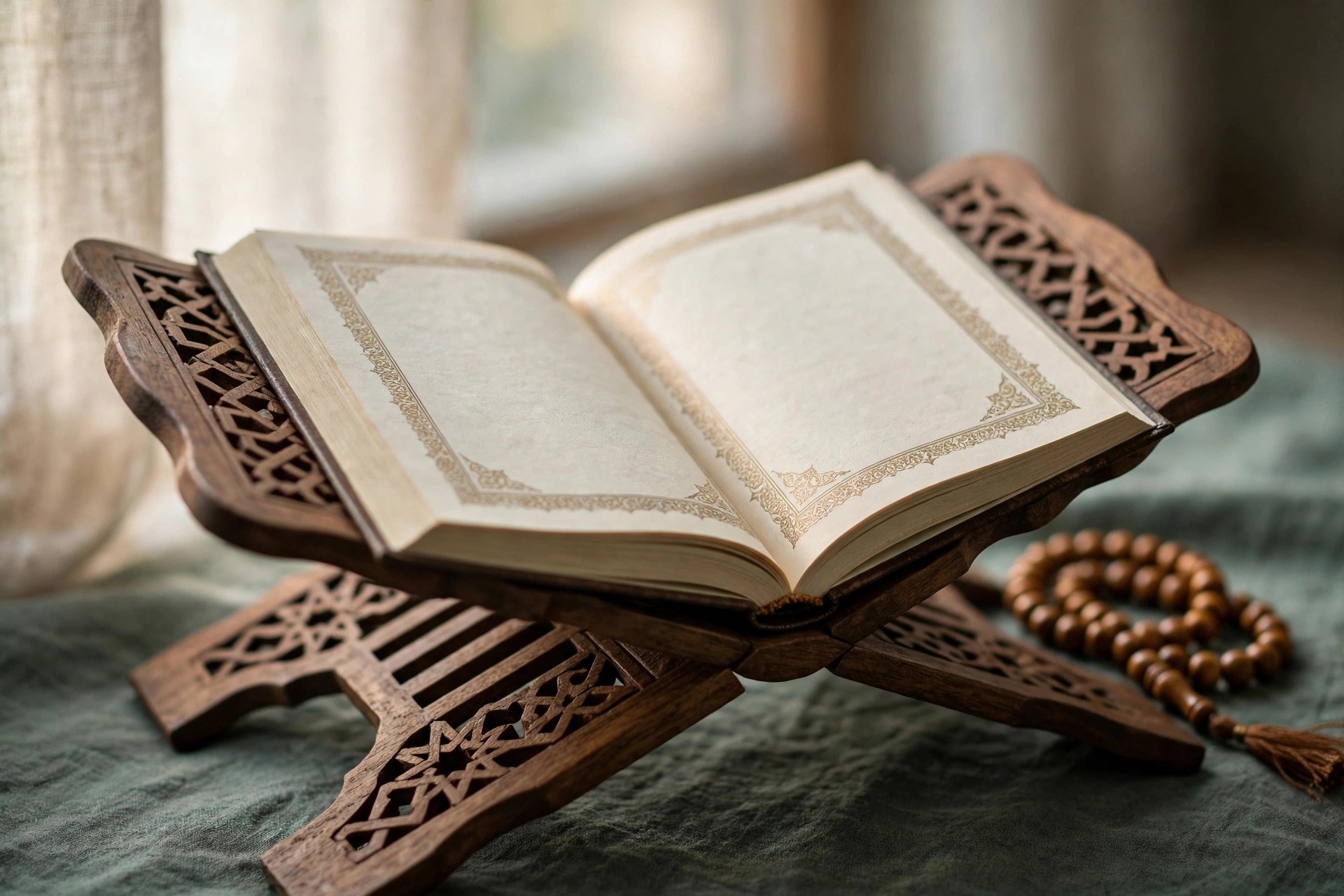
A quieter, but very common, image is the Quran resting open on a rehal — the wooden stand used for reading — in a clean, peaceful room or in a mosque. No one is reading it in the dream. It is simply there, open, waiting.
This image is traditionally understood as a sign of guidance being available and waiting for you. The open Quran is an invitation that has not yet been taken up. It can be a gentle reminder that the Quran is there for you, open and accessible, and that all you need to do is sit down and read.
People often have this dream when they know, in their hearts, that they have been neglecting the Quran. Life gets busy, work takes over, the phone takes over, and the Quran sits on the shelf, closed. The dream shows it open — as if to say, it is not too late, and it is not closed to you. That is a hopeful image, not a guilt trip. Guilt that pushes you away from Allah is not helpful; a gentle reminder that pulls you back towards Him is.
If the room in the dream was a mosque, or a place that felt sacred and calm, that adds to the sense of peace. Traditionally, seeing the Quran in a mosque in a dream is associated with community, worship, and the blessings of gathering for the sake of Allah. If you have been praying alone for a long time, this dream might be a quiet encouragement to reconnect with the mosque and with other believers, even in a small way.
The Quran Falling, or Pages That Are Damaged
This is the scenario people worry about most, so let us handle it with care and honesty. Sometimes a person dreams that the Quran falls from their hands, or slips from a shelf, or that its pages are torn, wet, or damaged. They wake up feeling upset, guilty, or afraid that something bad is going to happen. If that was your dream, please take a slow breath. A distressing dream is not a curse, and it is not a prediction.
First, remember the three kinds of dreams. A frightening or upsetting dream is, in the Islamic understanding, from Shaytan, and its purpose is to disturb you. The proper response is not to panic, but to seek refuge in Allah, to pray, and to let the dream go. Do not spend days trying to work out what terrible thing it means. That is exactly what a disturbing dream wants you to do.
Second, even in the traditional literature, a dream in which the Quran is mishandled is generally understood as a warning or a reminder, not as a punishment. Classical interpreters generally associated such images with neglect of the Quran in waking life — not reading it, not acting on it, or treating it without the respect it deserves. If that description fits your life right now, then the dream is doing you a kindness by showing you the gap. It is an invitation to close that gap, not a sentence against you.
Third, and most importantly, a dream does not change your standing with Allah. Your sins are forgiven by repentance, not by dreams. Your good deeds are not cancelled by a bad dream. If you accidentally dropped a Quran in real life, you would pick it up, say sorry to Allah in your heart, and be more careful next time. A dream in which that happens deserves the same response: acknowledge it, make a small intention to treat the Quran with more care and read it more often, and move on.
What you should not do after such a dream is also clear. Do not go to people who claim they can tell you exactly what will happen to you, and do not pay anyone for a dream interpretation that promises to protect you from harm. Do not spread the dream around to everyone you know, asking for opinions that will only confuse you. And do not let one unsettling night undo months of good habits. If you need to talk about it, speak to one knowledgeable, trustworthy person — an imam or a scholar you respect — and then leave it with Allah.
If the Quran in your dream was damaged but you were trying to repair it, or protect it, or pick up its pages with care, that is a hopeful detail. It suggests a heart that wants to make things right. That desire to repair and protect is, in itself, a good sign. Hold onto that, and let it guide what you do next.
What Classical Islamic Dream Literature Says — In General Terms
When people ask what seeing the Quran in a dream means, they are often really asking what the classical scholars of dream interpretation said about it. That is a fair question, because Muslims have been writing about dreams for more than a thousand years, and the tradition is rich and thoughtful. But it is also a question that needs an honest answer: the classical books do not give a single, fixed meaning for every dream, and they were never meant to be used like a dictionary where you look up a symbol and get one answer.
The most famous name in this field is Ibn Sirin, a scholar of the early generations whose name became attached to a whole tradition of dream interpretation. Books written in his tradition — and in the tradition of other classical interpreters — treat the Quran as one of the most positive symbols in dreams. In general terms, the classical literature associates seeing the Quran with guidance, knowledge, wisdom, justice, and a return to the truth. Reading it is associated with an increase in knowledge and understanding. Memorising it is associated with knowledge becoming firm. Receiving it is associated with blessing and guidance coming to the dreamer.
It is important to be honest about the limits here. We are not quoting a specific passage or a specific line from a classical book in this article, because dream books have been copied, added to, and translated many times over the centuries, and it is easy to attribute a sentence to a scholar that he never actually wrote. What we can say, truthfully and carefully, is that the broad, general association in the classical tradition is consistent: the Quran in a dream is a symbol of good. That general agreement across the tradition is meaningful in itself, and it is enough for the purpose of reflection — you do not need a word-for-word quote to take comfort from a good dream.
Classical interpreters also paid close attention to the details around the main symbol, and that is a useful habit to borrow. They would ask: was the Quran clean or dusty? Was it open or closed? Was it being read, or was it sitting untouched? Was the dreamer happy or afraid? Was the setting a mosque, a home, or an unknown place? Each detail added a shade of meaning. A clean, open Quran in a bright place was read differently from a dusty, closed Quran in a forgotten corner — not because the Quran itself had changed, but because the dreamer’s relationship with it had.
That way of reading dreams is worth keeping in mind. It stops you from treating a dream as a simple good-or-bad label, and it invites you to think about your own life. If the Quran in your dream was dusty and neglected, the honest question is not “what bad thing will happen to me?” but “have I been neglecting the Quran, and what would it look like to return to it?” If the Quran in your dream was bright, open, and being read with love, the question is not “what reward will I get?” but “how can I keep this feeling alive when I am awake?”
The classical scholars also understood something modern readers sometimes forget: the same dream can mean different things for different people. A dream about reading the Quran might mean one thing for a scholar who teaches it every day, another thing for a new Muslim who is just learning to read it, and another thing for someone who has drifted away from it for years. The symbol is the same, but the person is different, and the meaning lives in the meeting between the two. That is why the best dream interpreters in the Islamic tradition always asked about the dreamer’s life before they offered an interpretation — and why you should be cautious of anyone who offers a confident interpretation without knowing anything about you.
Finally, the classical tradition is clear on one point that matters more than any symbol: a good dream should lead to good action. If a dream about the Quran makes you feel closer to Allah, more grateful, more honest, or more eager to read and learn, then the dream has done its work — whatever its exact interpretation. If a dream makes you arrogant, fearful, or obsessed with hidden meanings, then something has gone wrong in how you are using it, even if the dream itself was good. The test of a dream is not how impressive it sounds when you tell it to others, but what it does to your heart and your actions when you are awake.
The Dream of Prophet Yusuf — Why Dreams Matter in Islam
It is worth pausing here to remember why Muslims take dreams seriously at all, without taking them too far. The Quran itself gives us a powerful example in the story of Prophet Yusuf, peace be upon him. In Surah Yusuf 12:4, Yusuf tells his father about a dream in which he saw eleven stars, the sun and the moon bowing down to him. His father, Prophet Yaqub, understood that this was a meaningful dream, and he advised his young son to keep it to himself.
That story is loved by Muslims for many reasons, but one of them is that it shows dreams can carry real meaning, and that their meaning sometimes takes years to unfold. Yusuf’s dream did not come true the next day, or the next year. It came true after a long journey — through jealousy, betrayal, slavery, prison, and eventually a position of honour in Egypt — when his family finally bowed before him, not in worship, but in respect and reunion. The dream was true, but its fulfilment was slow, and it was woven through hardship as well as blessing.
That is a helpful way to think about a dream about the Quran. It may not be a prediction about tomorrow. It may be a seed — a sign of where your life is heading, or where your heart wants to go, or what Allah is inviting you towards over the long term. You do not need to work out the whole story today. You just need to take the next small step in the direction the dream pointed you.
Yusuf’s story also teaches discretion. His father told him not to share the dream with his brothers, because not everyone will receive a good dream with good intentions. That advice applies to our dreams too. A beautiful dream about the Quran is a gift, and gifts are not always meant to be shown to everyone. Share it with someone you trust, if sharing will help you, but there is no need to announce it widely or to seek praise for having had it. The value of a good dream is in what it does to your private relationship with Allah, not in how many people hear about it.
And there is one more lesson in Yusuf’s story that is easy to miss: his dream was about his family, his future, and his relationship with Allah — not about hidden knowledge, magic, or secret powers. Dreams in Islam are not a shortcut to knowing the unseen. They are, at their best, a source of comfort, encouragement, and reflection for a believer who is already trying to live well. That is enough. It is more than enough.
What to Do After Dreaming About the Quran
So you have had the dream. You have read about what it might mean. Now what? This is the most practical part of the article, and in many ways the most important, because a dream that does not change anything in your waking life is a missed opportunity — however beautiful it was.
The first thing to do is simple: thank Allah. If the dream was good and left you feeling peaceful, say alhamdulillah, from your heart, not just with your tongue. Gratitude is the proper response to a blessing, and a good dream is a blessing. You do not need to make a big show of it. A quiet moment of thanks, perhaps after Fajr prayer, is enough. If you woke up for Tahajjud or Fajr after the dream, that itself is a good sign — take it as a gift and use the quiet of the early morning to pray and reflect.
The second thing is to read the Quran — today, not someday. It does not have to be a lot. A few verses, read slowly, with their meaning, are worth more than a whole chapter rushed through without understanding. If you heard a particular verse in your dream, start with that verse. Read it, read its translation, and think about what it means for your life right now. If you do not remember a specific verse, start wherever you left off, or open the Quran at a place you love. The point is to let the dream turn into action, in a small and sustainable way.
The third thing is to reflect honestly. Ask yourself a few quiet questions, without judging yourself harshly. How is my relationship with the Quran right now, really? Am I reading it regularly, or has it become something I only think about in Ramadan? Am I acting on what I already know, or am I collecting knowledge without living it? Is there a particular sin, habit, or worry that is keeping me distant from Allah, and is this dream an invitation to deal with it? You do not need to answer all of these at once. One honest answer is enough to start with.
The fourth thing is to pray for guidance. If you are facing a decision and the dream felt connected to it, pray Istikhara — the prayer for guidance — and consult people you trust. A dream can encourage you, but Istikhara and consultation are the Islamic ways of making a decision. Do not treat the dream as a substitute for them. Instead, let the dream be one more reason to turn to Allah in prayer and ask Him to show you the right path.
The fifth thing is to take one small, concrete step. Dreams fade quickly if they are not followed by action. Choose one step you can actually keep: reading a page of Quran after Fajr, listening to ten minutes of recitation on your way to work, learning the meaning of a short surah you already recite in prayer, joining a Quran class, or teaching your child a verse. Small steps, done consistently, change a life more than grand intentions that last a week. The dream was a reminder; the step is the response.
If the dream was unsettling, the steps are slightly different. Seek refuge in Allah by saying “A’udhu billahi min ash-shaytan ir-rajim” — I seek refuge in Allah from the accursed Shaytan. Pray, even if it is just two rak’ahs. Do not share the dream widely, and do not go looking for a frightening interpretation. If you feel you need to talk about it, speak to one knowledgeable and trustworthy person, and then let it go. The Islamic teaching on bad dreams is deliberately simple: seek refuge, pray, and do not let it control you. That simplicity is a mercy.
Finally, be patient with yourself. A single dream, however powerful, does not transform a person overnight. Spiritual growth is slow, uneven, and often invisible — like a seed growing underground before it breaks the surface. If you return to the Quran a little more often, pray a little more sincerely, and treat people a little more kindly because of a dream, then the dream has borne fruit. That is the real measure of its meaning.
Cautions: What a Dream About the Quran Does Not Mean
Because dreams about the Quran feel so significant, they also attract a lot of misunderstanding. It is worth naming the most common mistakes plainly, so you can avoid them.
First, a dream about the Quran does not make you a saint, a scholar, or a chosen person. It does not mean your sins are forgiven automatically, or that you are guaranteed Paradise, or that you have a special rank with Allah. These are serious matters in Islam, and they depend on faith, repentance, and righteous deeds over a lifetime — not on a single night’s sleep. If a dream makes you feel proud or superior to others, that pride is a warning sign in itself. A true blessing increases humility, not arrogance.
Second, a dream does not give you religious authority. If you dream about the Quran, you have not been given a new ruling, a new interpretation of a verse, or permission to teach others something that contradicts what scholars have established. The Quran is interpreted through knowledge, study, and the understanding of qualified scholars — not through private dreams. If a dream seems to suggest a new meaning of a verse that no scholar has taught, be very cautious. The safest path is to ask a qualified teacher, and to hold onto the established understanding until you have clear evidence otherwise.
Third, a dream is not a fortune-telling device. Seeing the Quran in a dream does not tell you that you will get a job, pass an exam, recover from an illness, or marry a particular person. It may encourage you and give you hope, and hope is a beautiful thing — but hope is not a guarantee. Do not make financial, medical, or family decisions based on a dream alone. Use the ordinary, sensible means Allah has given you: medical advice for health, sound planning for work and money, and consultation and prayer for family matters.
Fourth, beware of anyone who claims to interpret your dream with complete certainty, especially if they ask for money. Dream interpretation is a subtle and uncertain art, even for scholars. Anyone who tells you, without knowing your life, that your dream means exactly this will happen on exactly that day is not speaking with knowledge — they are guessing, or worse, taking advantage of your hope or fear. The honest interpreters in the Islamic tradition always spoke in terms of possibility and hope, not certainty, and they always asked about the dreamer’s life first.
Fifth, do not let a dream become an obsession. Some people have a beautiful dream and then spend weeks or months trying to decode every detail, searching the internet for meanings, asking everyone they meet, and worrying that they will miss the message if they do not get it exactly right. That is not what dreams are for. A dream is meant to be received, reflected on briefly, acted on simply, and then released. If you find yourself anxious about a dream, that anxiety is a sign to step back, pray, and focus on the clear, everyday duties of faith — prayer, kindness, honesty, and reading the Quran — rather than on hidden meanings.
Finally, remember that the Quran itself is the surest guide you have, whether you dream about it or not. You do not need a dream to know that reading the Quran is good, that prayer is good, that kindness is good, and that turning to Allah is good. Those truths are already clear. A dream can remind you of them, and that reminder is precious — but the truths themselves do not depend on the dream. If you never have another dream about the Quran in your life, you still have the Quran itself, open and available, every single day. That is the greatest blessing of all.
Frequently Asked Questions
Is seeing the Quran in a dream a good sign in Islam?
In general, yes. Seeing the Quran in a dream is traditionally understood as a positive and hopeful sign in Islamic thought, because the Quran represents guidance, knowledge, and light. Classical interpreters generally associated it with closeness to Allah, an increase in understanding, and a reminder to turn towards the Quran. That said, the feeling of the dream and the details around it matter, and no single dream is a guarantee about the future. The most useful way to receive it is with gratitude and as encouragement to read and live by the Quran more closely.
What does it mean to dream of reading the Quran?
Dreaming of reading the Quran is traditionally understood as a sign of guidance and knowledge. If you read clearly and with ease in the dream, it is often taken as a sign that your heart is open to guidance. If you struggled to read, it is more often understood as a gentle reminder to give the Quran more attention in your daily life — to read regularly, even a little, and to learn the meaning of what you read. In both cases, the practical response is the same: read a little Quran today, slowly and with understanding.
What does it mean if someone gives me the Quran in a dream?
Receiving the Quran as a gift in a dream is traditionally understood as a sign that guidance and blessing are being offered to you. It is often read as an invitation to take the Quran more seriously in your life — to open it, read it, and let it guide you. If the giver was someone you respect, the dream may also reflect that person’s good influence on your faith. The focus is on the gift itself rather than on who gave it, and the kindest response is to accept the invitation in your waking life.
I dreamed the Quran fell or its pages were damaged. Should I be worried?
Please do not panic. A distressing dream is, in the Islamic understanding, from Shaytan, and its purpose is to make you anxious. The proper response is to seek refuge in Allah, pray, and let the dream go. In traditional terms, such a dream is generally understood as a reminder rather than a punishment — a sign that your connection with the Quran may need attention. Pick up the Quran, read a little, make a sincere intention to treat it with care, and move on. One bad dream does not change your standing with Allah, and it is not a prediction that something bad will happen.
Does a dream about the Quran mean I will become a hafiz or a scholar?
Not necessarily. A dream about memorising or reciting the Quran is traditionally associated with knowledge taking root in the heart, and it can be a beautiful encouragement for someone who is learning or memorising. But it is not a promise that you will complete memorisation or become a scholar. Those things come through years of patient effort, study, and teaching. If the dream encourages you to start or continue learning, that encouragement is valuable in itself — take it as motivation, not as a guarantee.
Can a dream tell me to do something the Quran does not allow?
No. This is an important principle in Islam: no dream overrides the Quran and Sunnah. Dreams are a source of glad tidings and encouragement, not a source of religious law. If a dream seems to tell you to do something forbidden, or to stop doing something obligatory, do not follow the dream. That is a strong sign to step back, seek refuge in Allah, and speak to a knowledgeable person if you are confused. Big decisions should be made with prayer, consultation, and sound thinking, not with a dream alone.
Should I tell others about my dream of the Quran?
You can, but you do not have to, and it is often wiser to be selective. The story of Prophet Yusuf teaches us that a meaningful dream is not always meant to be shared with everyone. Share it with someone you trust — a spouse, a parent, a teacher, or a knowledgeable friend — if sharing will help you reflect or find encouragement. Avoid sharing it widely in search of praise, and avoid sharing a frightening dream with many people. A good dream is most valuable in your private relationship with Allah, not in how many people hear about it.
What should I do the morning after dreaming about the Quran?
Keep it simple. Thank Allah, pray, and read a little Quran — even a few verses with their meaning. Reflect honestly on your relationship with the Quran and choose one small step you can keep, such as reading a page after Fajr or listening to recitation during your day. If the dream was unsettling, seek refuge in Allah, pray, and do not dwell on it. You do not need to decode every detail. A short reflection followed by a small, steady action is the best response to a good dream.
Does the same dream mean the same thing for everyone?
No, and this is something the classical tradition understood well. The same symbol can mean different things for different people, because a dream is shaped by the dreamer’s life, intentions, and circumstances. A dream about reading the Quran means something different for a teacher who reads it every day than it does for someone who has not opened it in years. That is why honest interpretation always considers the person, not just the symbol, and why you should be cautious of anyone who offers a fixed meaning without knowing anything about you.
I keep dreaming about the Quran. Does that mean something special?
Repeated dreams about the Quran often reflect a deep and ongoing connection with it in your waking life — perhaps you have been thinking about it a lot, reading it regularly, or longing to return to it. In traditional terms, a repeated good dream can be understood as continued encouragement. Rather than searching for a hidden or special meaning, take it as a steady invitation: keep the Quran close, keep reading, and keep letting it shape your life. If the repeated dreams are distressing, speak to a knowledgeable and trustworthy person, and focus on the everyday practices of faith that bring peace.
Whatever your dream looked like — an open Quran on a stand in a quiet room, a clear voice reciting verses you love, a gift placed gently in your hands, or a page you were trying to read with all your heart — the invitation at the centre of it is the same, and it is a kind one. Come back to the Quran. Not in fear, and not in a rush to decode a mystery, but slowly, honestly, and with hope. Read a little today. Sit with a verse and its meaning. Let the words you heard in sleep become words you live with while you are awake. That is how a dream becomes more than a memory. That is how it becomes a turning point — quiet, steady, and real — and may Allah make the Quran a light for you in this life, a comfort in your hardest moments, and a companion that stays with you long after this dream has faded. Ameen.
