Most dreams fade before breakfast. A camel dream usually does not. It stays with you, and there is a good reason for that. A camel is not a small, everyday image. It is a big, patient, stubborn animal that carries heavy loads across long distances, and when it shows up in your sleep, your mind is usually trying to tell you something about endurance, a journey, or a burden you are carrying in real life.
In this article, we will look at what seeing a camel in a dream can mean from an Islamic point of view. We will go through the most common scenarios one by one — riding a camel, seeing a white camel, a camel in the desert, a camel chasing you, and several others — and we will also look at what classical Islamic dream literature says about the camel. Everything here is written in simple English, and where something is not certain, we will say so plainly. Dream interpretation is not a fixed science with one answer for every person. The same dream can mean different things for different people, depending on their life, their worries, and their situation.
Before we go further, one honest point needs to be made right at the start. There is no specific hadith that fixes one single meaning for a camel dream. The Prophet Muhammad (peace be upon him) taught in general terms that a good dream is from Allah and a troubling dream is from Shaytan, and that a believer should be grateful for a good dream and seek refuge from a bad one. That general teaching is well known, but it does not give us a ready-made meaning for every animal or object. The meanings discussed in this article come from classical tabeer literature — the books of scholars like Ibn Sirin and Imam Jafar Sadiq — and from the way the camel has always been understood in Arab and Islamic culture: as a symbol of patience, strength, and long journeys. Treat these interpretations as guidance and reflection, not as a ruling about your future.
Quick Summary: What Does a Camel Mean in a Dream?
If you want the short answer first, here it is. In Islamic dream interpretation, a camel most often points to patience and endurance. It is the animal that keeps walking when everything else stops. It can also point to a long journey, a heavy responsibility, or a strong and patient person in your life. Sometimes it points to a burden that is weighing you down. The exact meaning depends on what the camel was doing in the dream and how you felt while watching it.
A calm camel that you are riding peacefully usually carries a positive meaning — steadiness, progress, and the ability to keep going. A camel that is angry, chasing you, or loaded down until it can barely walk usually points to stress, a burden, or a problem you have been avoiding. A white camel is often read as a hopeful sign, while a dead camel is usually read as a warning that something in your life has come to an end or needs attention. A baby camel often points to a new beginning, a small responsibility, or something that needs your care and patience to grow.
None of this is a prediction. A dream does not force your future. It is more like a mirror. It shows you what is already on your mind — the journey you are on, the load you are carrying, or the patience you need. Keep that in mind as you read the scenarios below, and pay attention to the one that matches how you actually felt in the dream. Your own feeling during the dream matters as much as the image itself.
Riding a Camel in a Dream
Riding a camel is one of the most common camel dreams, and it is also one of the most encouraging. A camel is a riding animal, and to ride one calmly in a dream usually means you are in control of a long journey — not a quick trip, but something that takes time, like a career, a marriage, a move to a new country, or a big personal goal. The camel moves slowly, but it does not stop. That is the point. The dream may be telling you that you are making progress even if it does not feel fast.
If the ride was smooth and the camel obeyed you, classical interpreters often read this as a sign of steadiness and success through patience. You are handling a difficult path well. If the camel was hard to control, kept stopping, or threw you off, the meaning changes. It may mean you feel you have lost control of a situation, or that the journey you are on is harder than you expected. It is worth asking yourself what long task in your life feels like that right now.
There is also a practical side to this dream. A camel ride in a dream sometimes appears before an actual journey — a trip, a move, or a new phase of life. In older times, the camel was the main way people travelled long distances, so a camel in a dream was naturally connected to travel. Today, the journey is often a metaphor, but the feeling is the same: you are going somewhere, and it will take time and patience to get there.
Seeing a White Camel in a Dream
A white camel is a striking image, and in dream literature it is usually read as a hopeful and positive sign. White, in Islamic tradition, is associated with purity, peace, and good news. A white camel can point to a blessing, a good person entering your life, or a period of calm after a difficult time. Some interpreters connect it with a noble and patient person — someone who is strong but gentle, and who carries others without complaint.
If the white camel came towards you peacefully, or if you felt happy and calm while looking at it, the dream is often read as a sign of relief and good fortune. It may mean that a worry you have been carrying is about to ease, or that help will come from an unexpected direction. If you were riding the white camel, the meaning is stronger still — it can suggest honour, dignity, and a journey that ends well.
It is worth being honest here too. A white camel does not guarantee that something good will happen tomorrow. What it does suggest, in the language of dreams, is that your heart is leaning towards hope. That matters. When you wake up feeling peaceful after such a dream, take it as encouragement to keep going, to keep praying, and to keep treating people well. The best response to a hopeful dream is gratitude and continued effort, not sitting back and waiting.
A Camel in the Desert
A camel standing or walking in the desert is a powerful image because it is exactly where the camel belongs. The desert is harsh, hot, and empty, and the camel is the one animal built to survive it. Seeing a camel in the desert in a dream often speaks to your own ability to survive a hard period. You may be going through a dry patch — money is tight, a relationship is strained, or work feels endless — and the dream is showing you that you have more endurance in you than you think.
If the camel was walking steadily through the desert, the dream is often read as a sign that you will get through the difficulty. The desert does not last forever, and the camel keeps walking until it reaches water. If the camel was lost, thirsty, or struggling in the desert, the meaning is different. It may mean you feel lost or exhausted, and that you need rest, help, or a change of direction. A camel that cannot find water in a dream is a picture of a person who has been giving and giving without being replenished.
Ask yourself what your desert is right now. Is it a job that drains you? A family situation that never seems to improve? A period of waiting for something — a visa, a marriage proposal, a job offer, a medical result? The dream does not name the problem. It shows you the picture of endurance, and invites you to think about where you need to be patient and where you need to ask for help.
A Camel Attacking or Chasing You
A camel chasing you or attacking you in a dream is frightening, and it usually means something in your waking life feels threatening or overwhelming. Camels are not normally aggressive animals, so an angry camel in a dream stands out. In classical interpretation, an attacking camel can represent a powerful person who is angry with you, a heavy burden that has become too much, or a problem you have been running away from that is now catching up with you.
If the camel caught you, the dream may be telling you that you cannot keep avoiding the issue. It might be a debt, a difficult conversation, a responsibility you have been putting off, or a habit you know is harming you. If you escaped from the camel, the dream is often read more hopefully — you have the strength to get away from the pressure, but you still need to deal with it properly rather than just running.
It helps to ask who or what the camel might represent. Is there a person in your life who is strong, stubborn, and hard to argue with? Is there a workload or a family expectation that feels like it is chasing you every day? Sometimes the camel is not a person at all. It is the weight of your own responsibilities, grown so large that it feels like a separate creature chasing you. Naming the pressure is often the first step to handling it. A troubling dream like this is also a reminder to seek refuge in Allah from Shaytan, and to take practical steps in the daytime — talk to the person, make a plan, ask for help — rather than only worrying at night.
Drinking Camel Milk in a Dream
Drinking camel milk in a dream is one of the more positive camel scenarios. Camel milk has a long history in Arab culture as a nourishing, healing drink, and in dream literature it is often connected with lawful earnings, good health, and benefit from a patient and generous person. If you drank the milk and it tasted good, the dream is often read as a sign of sustenance coming your way — perhaps a new source of income, a helpful opportunity, or recovery from an illness.
Some classical interpreters connect camel milk with wealth that comes through patience rather than through quick gain. It is not lottery money. It is the kind of provision that arrives slowly, like the camel itself, but lasts. If you were given the milk by someone in the dream, that person may represent a source of help or benefit in your life. If you milked the camel yourself, it can suggest that your own hard work and patience will bring you benefit.
If the milk tasted sour or bad, or if you felt sick after drinking it, the reading changes. It may point to earnings that are doubtful, a benefit that comes with a cost, or a health matter that needs attention. Again, the feeling in the dream is the key. A nourishing drink that leaves you satisfied is a very different dream from one that leaves you feeling unwell.
A Camel Carrying a Heavy Load
A camel loaded with goods, bags, or a heavy burden is one of the clearest pictures in dream language. The camel is the beast of burden, and a loaded camel usually represents a responsibility — yours, or someone else’s that you have taken on. If the camel was carrying its load well and walking steadily, the dream can be a positive sign: you are strong enough to carry what life has given you, and you are doing it with patience.
If the load was too heavy, the camel was struggling, or the load kept falling off, the dream is usually a warning about overload. You may be carrying too much — too many people’s problems, too many commitments, too much work, or a secret that is weighing on you. The dream is showing you the load from the outside, so you can see how heavy it actually is. Many people only realise they are overloaded when they see the picture in a dream.
This is a practical dream, and it calls for a practical response. Make a list of what you are carrying right now. Which of those things are truly yours? Which ones could you share, postpone, or put down? In Islamic teaching, patience is a virtue, but patience does not mean accepting a load that is breaking you. The Prophet (peace be upon him) taught balance — fulfilling your duties without destroying yourself. If a camel dream shows you a load that is too heavy, take it seriously in your waking life.
Seeing a Baby Camel in a Dream
A baby camel in a dream is a gentle image, and it usually points to something new and small that needs your care. It can represent a new responsibility, a new project, a young child in the family, or a new stage in your own life that is still fragile. Like a real baby camel, the thing it represents cannot look after itself yet. It needs patience, feeding, and time to grow strong.
If you were caring for the baby camel, feeding it or protecting it, the dream is often read as a sign of a new beginning that will grow well if you look after it. It may be a new business, a new marriage, a new habit of prayer, or a child. If the baby camel was lost, hurt, or alone, the dream may be pointing to something new in your life that is being neglected. Is there a project you started with enthusiasm and then forgot? A relationship that needs attention? A good habit that has slipped?
There is also a softer reading. A baby camel can simply represent innocence and the need for gentleness — towards yourself as well as others. If you have been harsh with yourself lately, pushing yourself without rest, the dream may be a reminder to be patient with your own growth. Big camels were once small ones. They grew strong slowly, one day at a time.
A Camel in Your House
Seeing a camel inside your house is an unusual dream, and its meaning depends a great deal on what the camel was doing there. A house in a dream usually represents your family life, your private world, or yourself. A camel in the house can mean that a big responsibility, a strong person, or a long journey has entered your family life. If the camel was calm and resting in the house, some interpreters read it as a sign of a patient and strong person joining the household — perhaps a new family member, a helpful guest, or a blessing coming into the home.
If the camel was causing damage, knocking things over, or making the house feel crowded, the meaning is very different. It may mean that a burden or a difficult person has entered your home life and is disrupting your peace. It could be a family disagreement, a financial pressure that affects everyone in the house, or a responsibility that has taken over your private space. A camel is a large animal, and a large animal in a small house is a picture of something that does not fit where it has been placed.
Pay attention to how the other people in the dream reacted. Were they calm, frightened, or welcoming? Their reactions often mirror how your family feels about the situation in real life. If the dream left you feeling uneasy about your home, it is worth looking at what has changed in your household recently, and whether something large — a problem, a person, or a commitment — needs to be addressed before it does more damage.
Seeing a Dead Camel in a Dream
A dead camel in a dream is a sad image, and it is usually read as a sign of an ending. It can mean the end of a period of patience, the loss of a source of support, or the end of a long journey. In classical interpretation, a dead camel sometimes points to the death of a strong and patient person, or to the loss of a livelihood that depended on endurance and hard work. That is a serious reading, and it should not be taken as a prediction that someone will die. Dreams do not work like that. They speak in pictures, and a dead camel is the picture of something strong coming to an end.
More often, in everyday terms, a dead camel dream points to exhaustion. You may have reached the end of your patience with a situation — a job, a relationship, a long wait — and the dream is showing you that the old way of coping has died. That is not necessarily a bad thing. Sometimes an old burden has to end before a new chapter can begin. If you felt relief in the dream, the ending may be something you actually need. If you felt grief, it may be that you are mourning a loss, or afraid of losing something important.
After such a dream, it is natural to feel worried. The best response is to pray, to take care of your health and your relationships, and to look honestly at what in your life feels finished or worn out. Do not panic, and do not go around telling people that someone is going to die because of a dream. That is not how Islamic dream interpretation works, and it causes harm. A dream is a prompt to reflect and to act wisely, not a verdict.
A Caravan of Camels in a Dream
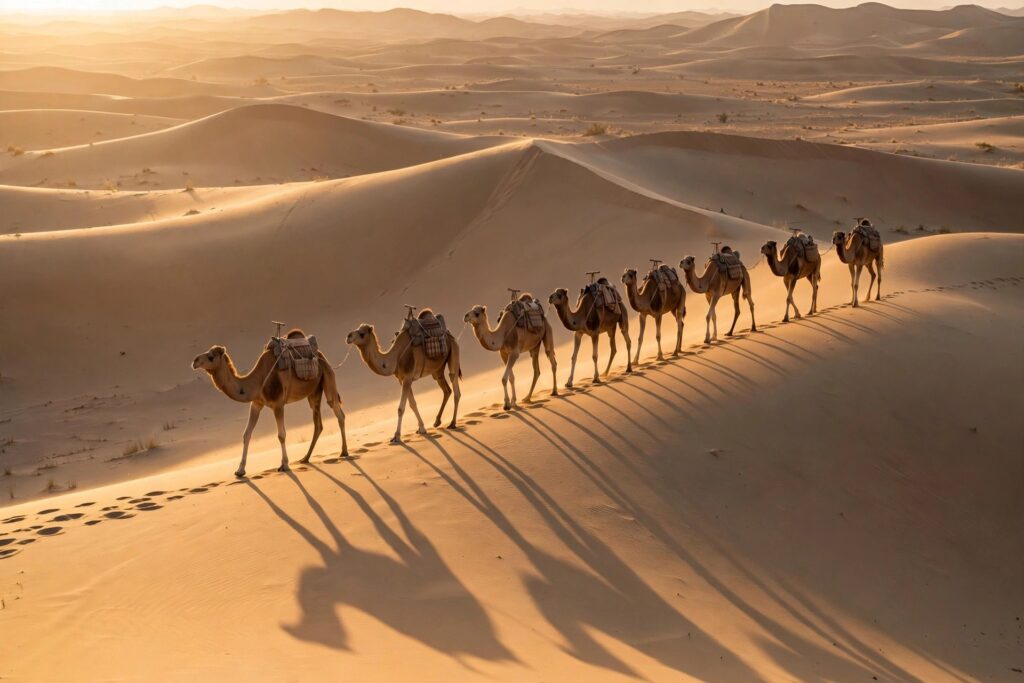
A caravan of camels — a long line of camels travelling together — is a grand image, and it often speaks about community, trade, or a shared journey. In older times, caravans carried goods across deserts, and travelling with a caravan was the only safe way to cross a long and dangerous route. Seeing a caravan in a dream can mean that you are part of something bigger than yourself: a family effort, a business venture, a migration, or a community project.
If the caravan was moving well, in an orderly line, the dream is often read as a sign of prosperity through cooperation. You are not travelling alone. If you were leading the caravan, it can suggest leadership and responsibility for others. If you were following at the back, it may mean you feel you are following others’ plans rather than your own, or that you are part of a group effort where your role is smaller but still important.
A caravan that was scattered, lost, or attacked has a different meaning. It can point to a group effort falling apart, a business partnership under strain, or a family that is no longer moving in the same direction. It can also point to travel plans that need rethinking. Either way, the dream invites you to think about the people you are travelling with in life — who is walking with you, and is everyone still heading the same way?
What Classical Islamic Dream Literature Says About the Camel
Now that we have gone through the scenarios, it is worth looking at what the classical books actually say. The most famous name in Islamic dream interpretation is Ibn Sirin, whose book of tabeer has been read for centuries. According to the tradition associated with him, the camel is generally interpreted as a strong and patient man, a long journey, or a heavy burden. The exact reading depends on the state of the camel and the dreamer’s own situation — a healthy, obedient camel points to strength and endurance, while a sick, stubborn, or overloaded camel points to hardship and burden.
Imam Jafar Sadiq is also quoted in the classical literature in connection with camel dreams, with the camel sometimes linked to a journey, a patient person, or a great and powerful figure. These attributions come from the books of tabeer that have been handed down over the centuries, and they are worth reading with respect — but also with honesty. The books were written in a different time, in a culture where camels were part of daily life, and their interpretations were always meant to be weighed against the dreamer’s own circumstances. A scholar of tabeer would never give a meaning without asking about the dreamer’s life.
There are a few themes that run through the classical literature, and they are worth remembering. First, the camel is patience. It is the animal that endures heat, thirst, and heavy loads without complaint. Second, the camel is the journey. It is the animal of long travel, and in a dream it often marks a long phase of life rather than a single event. Third, the camel is the burden. It carries what others cannot carry, and in a dream it can represent the responsibilities that only you can carry. Fourth, the camel is the strong person — someone in your life who is patient, stubborn, and hard to move, for better or for worse.
One thing the classical books agree on is that no single image has a single fixed meaning. Ibn Sirin himself is reported to have given different interpretations of the same dream to different people, because the dreamer’s life changed the meaning. That is the most important lesson from the classical literature. A camel dream for a trader waiting on a shipment means something different from a camel dream for a mother caring for a sick child. The image is the same. The life is different. Any honest interpretation has to start with the dreamer’s life, not with the book alone.
It is also important to say clearly what the classical literature does not do. It does not fix your future. It does not tell you the day something will happen. It does not replace prayer, patience, or practical action. The books are guides for reflection, written by scholars who understood that dreams are a part of human life worth thinking about, but not a substitute for living well in the daytime.
What to Do After Seeing a Camel in a Dream
So you have had a camel dream, and you have read through the meanings. What should you actually do now? The first step is simple: do not panic, and do not celebrate too early. A dream is not a promise and it is not a threat. It is a prompt. Take a moment to write down what you remember — what the camel was doing, where you were, how you felt. Dreams fade quickly, and the details matter more than the general image.
Second, think about your own life. What long journey are you on? What burden are you carrying? Is there a patient person in your life you should be grateful for, or a stubborn problem you have been avoiding? The dream will usually connect to something you already know about, even if you have not put it into words yet. Be honest with yourself about that connection.
Third, follow the general teaching of the Prophet (peace be upon him) about dreams. If the dream was good and left you feeling peaceful, thank Allah and share it with someone you trust if you wish. If the dream was troubling — a camel chasing you, a dead camel, a camel destroying your house — seek refuge in Allah from Shaytan, do not dwell on it, and do not go around announcing it as a prediction. You can also give charity, pray, and take a practical step in the daytime towards the problem the dream pointed to. That is the proper response to a worrying dream: prayer plus action.
Fourth, do not make big life decisions based on a dream alone. Do not quit your job, end a relationship, or spend money because a camel appeared in your sleep. Dreams are one small part of guidance. Real decisions need prayer, consultation with people you trust, and careful thought. If a dream keeps repeating, or if it is causing you real distress, speak to a knowledgeable and trustworthy person — an imam or a scholar you respect — and describe the dream fully, including your life situation. They can help you think it through properly.
Finally, take care of yourself. Many vivid dreams come when we are tired, stressed, or unwell. A camel dream may simply be your mind’s way of telling you that you need rest, that you have been carrying too much, or that you need to slow down. Sometimes the most Islamic response to a dream about endurance is to rest so that you can endure. Sleep well, eat well, keep your prayers, and be patient with yourself. The camel keeps walking because it knows how to pace itself. That is a lesson worth taking from the dream into your daily life.
Frequently Asked Questions About Camel Dreams
1. Is seeing a camel in a dream a good sign or a bad sign in Islam?
It is usually neither purely good nor purely bad — it depends on the details. A calm, healthy camel that you ride peacefully is generally read as a positive sign of patience, endurance, and steady progress. An angry, overloaded, or dead camel usually points to a burden, a difficulty, or an ending. The feeling you had in the dream is often the best guide to which way the meaning leans.
2. What does riding a camel in a dream mean?
Riding a camel calmly usually means you are in control of a long journey or a long-term task, and that patience will bring you through it. If the camel was difficult to control or threw you off, it can mean you feel you have lost control of a situation, or that the journey is harder than you expected.
3. What does a white camel mean in a dream?
A white camel is generally read as a hopeful sign — purity, peace, relief, or a blessing. It is often connected with a noble and patient person, or with a period of calm after difficulty. If you felt happy and peaceful in the dream, take it as encouragement, and respond with gratitude.
4. What does it mean if a camel is chasing me in my dream?
A camel chasing or attacking you usually points to a pressure or problem you have been avoiding — a debt, a difficult conversation, a heavy responsibility, or a powerful person who is angry with you. It can also represent your own burdens grown so large that they feel like they are chasing you. The dream is a prompt to face the issue in the daytime, not just to run from it.
5. Is there a hadith about seeing a camel in a dream?
No. There is no specific hadith that fixes one meaning for a camel dream, and any source that gives you a fabricated citation number for one is not reliable. What is well known in general terms is the Prophet’s teaching (peace be upon him) that a good dream is from Allah and a troubling dream is from Shaytan. The specific meanings of camel dreams come from classical tabeer literature, such as the works associated with Ibn Sirin and Imam Jafar Sadiq, and they are guidance for reflection, not fixed rulings.
6. What does drinking camel milk in a dream mean?
Drinking camel milk that tastes good is usually read as a positive sign — lawful sustenance, benefit through patience, or good health. It is often connected with provision that comes slowly but lasts. If the milk tasted bad or made you feel unwell, the reading changes and may point to doubtful earnings or a health matter worth attention.
7. What does a dead camel in a dream mean?
A dead camel usually points to an ending — the end of a period of patience, the loss of a source of support, or a long journey coming to a close. It is not a prediction that someone will die. More often it reflects exhaustion, or the sense that an old way of coping has finished. If the dream worries you, pray, take care of your health and relationships, and do not announce it as a prediction.
8. What does a baby camel mean in a dream?
A baby camel usually represents something new and small that needs your care — a new project, a new responsibility, a young child, or a new stage of life that is still fragile. If you were caring for it, the dream often suggests a new beginning that will grow well with patience. If it was lost or neglected, it may point to something new in your life that needs attention.
9. What does a caravan of camels mean in a dream?
A caravan usually speaks about a shared journey — a family effort, a business venture, a migration, or a community project. A caravan moving well and in order suggests prosperity through cooperation. A scattered or lost caravan can point to a group effort falling apart or people no longer moving in the same direction.
10. Should I tell others about my camel dream?
If the dream was good and left you feeling peaceful, you may share it with someone you trust, and you should thank Allah for it. If the dream was troubling, the general teaching is to seek refuge in Allah from Shaytan, not to dwell on it, and not to announce it widely as a prediction. If a dream keeps repeating or distresses you, speak privately to a knowledgeable and trustworthy person who can help you think it through with full knowledge of your situation.
A camel dream is, in the end, a picture of patience. The camel does not hurry, it does not complain, and it does not stop in the middle of the desert. It keeps walking until it reaches water. If you have seen a camel in your dream, take that picture with you into your waking life. Be patient with your journey, honest about the load you are carrying, and grateful for the strength you already have. And if the dream pointed to a problem, face it in the daytime with prayer and practical steps — that is where the meaning of a dream is truly answered.
